
.svg)
.svg)


VerifiedThreat uses Agentic AI agents to discover, validate, prioritize, and simulate security weaknesses simulating the same sequences a skilled attacker would use during a red team engagement.
For an article on traditional red team simulation using a human driven POC click here.
Traditional vulnerability scanning identifies known isolated weaknesses. Red teams identify exploitable attack paths.
VerifiedThreat bridges this gap by continuously ingesting general real-time threat data, discovering its applicability to the specific target platform, validating exploitability, and adapting to defensive controls in real time. The result is a far more realistic simulation of adversarial behavior - and a faster route from exposure discovery to security improvement.
The agents simulate the attack parameters, and use machine learning (ML) to subtly vary the attack parameters to seek to identify previously hidden exploits at machine speed.
Manual red team exercises of course remain essential, but they are expensive, periodic, and constrained by human time. VerifiedThreat expands coverage between engagements, validates assumptions continuously, and provides red teams with verified evidence-backed attack chains that reflect current conditions rather than historical snapshots. Working together, they can make an extremely powerful combination to improve overall security and provide demonstrable proof of effective risk reduction.
Key Stages of Agentic AI Vulnerability Testing in Red Team Simulation
Why Agentic AI Changes Red Team Simulation
Conventional scanners answer “What vulnerabilities exist?” VerifiedThreat asks “Which vulnerabilities can be chained into a successful attack?”
VerifiedThreat’s AI agents can:
- Concentrate on those assets which represent the most risk. Customer labelling of the asset criticality greatly improves the business risk validation and helps to ensure prioritisation by risk.
- Prioritize exposed services and identities.
- Attempt safe exploit validation and show the exact code and process used to detect the vulnerability.
- Interpret responses and adjust strategy.
- Pull together attack chains that could otherwise be missed
- Escalate privileges when conditions permit.
- Dynamically vary the attack parameters in response to the defence
- Stop when safety boundaries are reached.
This decision-making loop resembles the operational workflow of a human adversary far more closely than signature-based scanning.
For example, an attacker wishing to hit a payment gateway would first launch reconnaissance bots to test out the sequence of events needed to launch an attack. They might test to see if the login pages, WAF and firewall are protected from automated traffic, and test the payment gateway directly to determine the levels of security. The agents will use reverse proxies, mobile proxies, be programmed to evade CAPTCHA etc. change their attack rate to be lower than the defined rate-limit on the WAF. The human adversary would have to re-tool and re-deploy the reconnaissance attack in line with the defences. If weak perimeter defences are found - the target is MUCH more likely to be subject to full attack after the reconnaissance.
Autonomous Reconnaissance Creates Realistic Attack Context
Red teams spend significant effort understanding the environment before attempting exploitation. VerifiedThreat accelerates this phase by continuously gathering intelligence from multiple sources, and gathering all the relevant threat intel, contextual data, and exploitability tests all in one neat package with a wide range of API so it can plug into your existing stack.
Example Reconnaissance Workflow
Because the AI correlates these findings intelligently and continuously, it can identify relationships that manual assessments often miss, e.g. an exposed dev API sharing authentication infrastructure with production systems, and unprotected login, etc.
Exploit Validation Reduces Noise
One of the largest weaknesses of traditional scanning is false positives. Red teams require evidence, and need to focus on the critical assets that matter to the business.
VerifiedThreat can perform controlled validation steps such as:
- Showing the entire attack surface by stage with the relevant code and logs that can be tracked and authenticated.
- Ensuring the criticality of the asset is understood for prioritization.
- Verifying authentication bypass conditions.
- Testing file upload restrictions with harmless payloads.
- Confirming command execution in sandboxed contexts.
- Checking token scope misuse.
- Validating vulnerabilities without retrieving sensitive data.
This produces a much smaller set of confirmed exploitable findings, allowing red teams to focus on impact rather than the initial triage.
Attack Path Chaining Reveals What Matters Most
A single medium-severity vulnerability may be unimportant in isolation but critical when combined with another weakness.
Illustrative Attack Chain
In the screenshot below - you can see the exact sequence of account-take-over attack chain events that simulate the entire attack path.
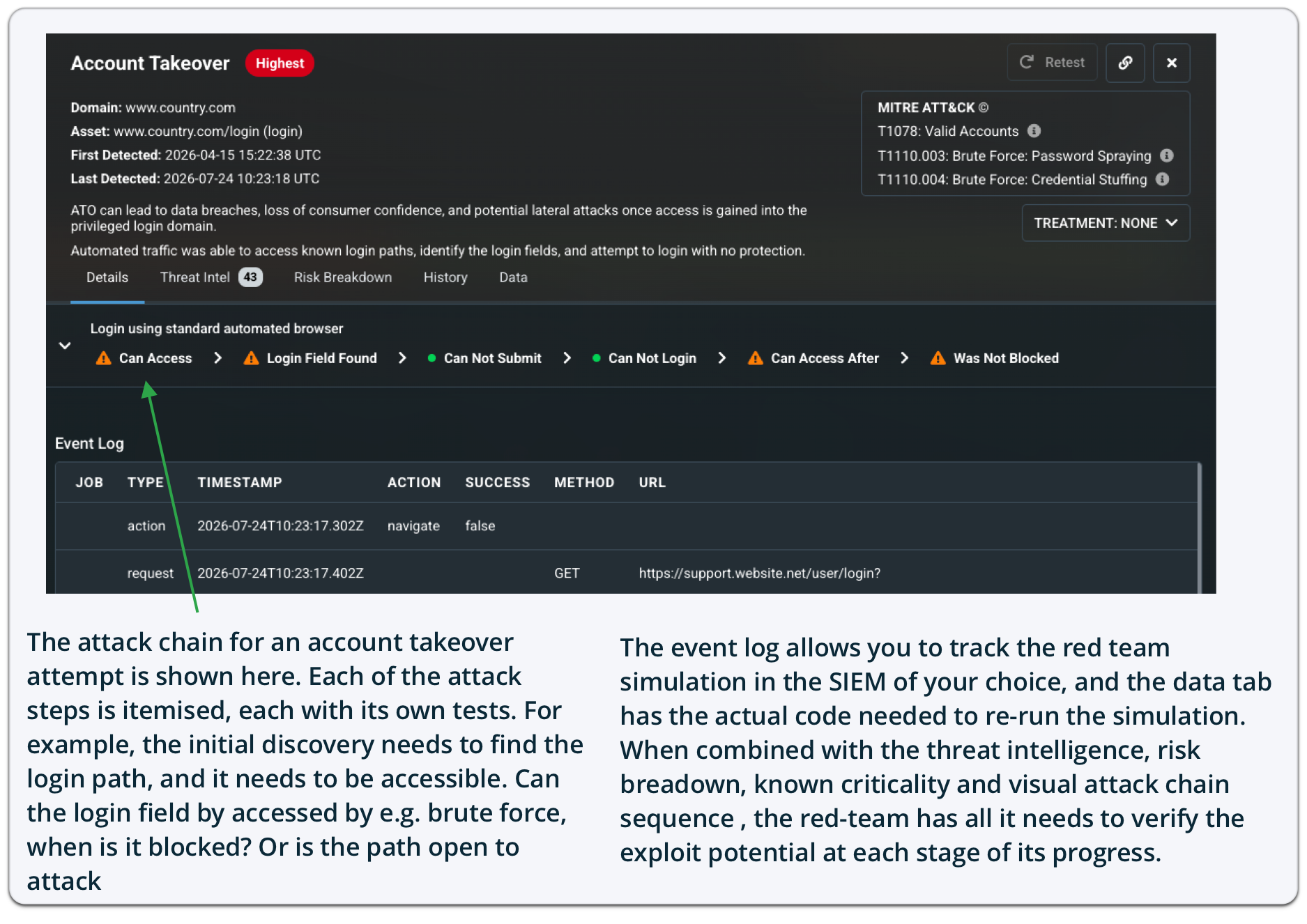
Traditional scanners would report five separate findings. Agentic AI identifies a complete intrusion path and quantifies the business impact.
Identity-Centric Red Team Simulation
Breaches frequently begin with identity abuse rather than software exploitation. VerifiedThreat is particularly effective at modeling identity attack paths, simulating account take-over, and MFA bypass.
Identity Checks Performed by AI Agents
- Account take over path protection
- MFA bypass opportunities.
- Legacy authentication exposure.
- OAuth consent abuse.
- Over-privileged service accounts.
- Dormant privileged accounts.
- Excessive cloud IAM permissions.
- Trust relationship abuse.
This provides red teams with a continuously updated map of privilege escalation opportunities across cloud and enterprise identity platforms.
Perimeter Defence Controls
A red team exercise is incomplete unless defensive controls are tested.
Agentic AI can generate controlled activity that exercises:
- WAF rules and limits including rate limiting
- SIEM correlation rules.
- CAPTCHA bypass
- Cloud threat detections.
- Identity protection alerts.
- API abuse monitoring.
- Network anomaly detection.
The resulting telemetry allows security operations teams to measure detection coverage, alert quality, and response timing against realistic attack behavior.
Continuous Red Teaming Between Engagements
Annual red team assessments provide valuable insight, but environments change daily.
Comparison
Continuous validation ensures that newly introduced exposures are identified shortly after deployment rather than months later.
Human Red Teams Become More Effective
VerifiedThreat can never replace expert red team operators. It increases their leverage.
AI Handles
- Asset enumeration and discovery
- Supplier threats
- Integrated threat intelligence / contextual
- Baseline reconnaissance.
- Asset criticality ratings
- Vulnerability validation.
- Attack path graph generation.
- Re-testing after remediation.
- Drives custom risk scoring
- Custom reporting using GenAI
Human Red Teamers Focus On
- Business logic abuse.
- Social engineering.
- Physical intrusion scenarios.
- Novel exploit development.
- Adversary emulation strategy.
- Objective-driven campaigns.
This division of labor produces deeper assessments within the same engagement window.
Practical Implementation Architecture
A mature deployment typically includes the following components:
The orchestration layer is critical because it enforces scope boundaries, rate limits, and safety policies.
Safety Controls for Agentic Security Testing
Autonomous testing must be governed carefully.
Essential controls include:
- Explicit asset allowlists.
- Time-window restrictions.
- Payload safety policies.
- Automatic stop conditions.
- Change-management approvals.
- Full audit logging.
- Segregated testing identities.
- Human escalation for high-risk actions.
These controls allow organizations to gain the benefits of autonomous validation without introducing operational risk.
Measuring Success
The VerifiedThreat dynamic agents allow for a much higher degree of effective program tracking operational outcomes rather than just counting the patch frequency. When combined with OKRs for cybersecurity, these metrics can prove to be a powerful management tool to enable real organisation risk reduction.

Key Risk Indicators can be set up and customised to keep track of the prioritized risk factors dynamically. This in turn drives custom GenAI reporting, so you can custom configure management reports and dashboards according to your business risk needs.
Common Use Cases
External Attack Surface Validation
Continuous discovery of exposed services, forgotten subdomains, and vulnerable internet-facing assets.
Pre-Red-Team Scoping
Rapid identification of the highest-value targets before a formal engagement begins.
Merger and Acquisition Security Reviews
Fast assessment of inherited environments and trust relationships.
Cloud Migration Assurance
Validation of IAM, network segmentation, and workload isolation after migration.
Purple Team Exercises
Coordinated testing of detection and response workflows with reproducible attack sequences.
A Realistic Enterprise Scenario
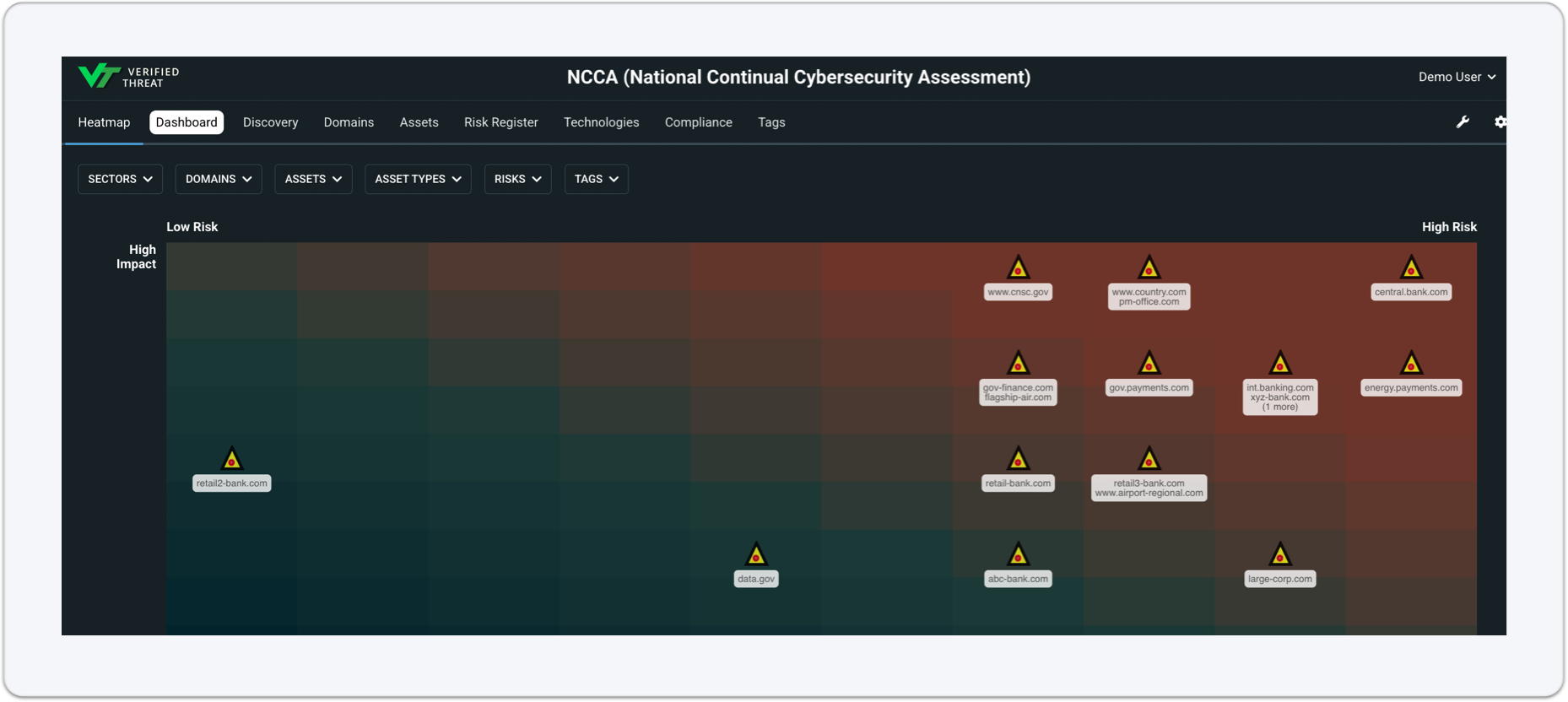
Consider a global enterprise with multiple cloud accounts, hundreds of SaaS applications, and remote workforce access. The VerifiedThreat platform was originally designed to simulate state-sponsored attack techniques against critical infrastructure, national security assets and enterprise environments. Through continuous monitoring, real-time threat intelligence, MITRE ATT&CK mapping, heatmaps, risk scoring and adaptive threat modelling, the global enterprise gains ongoing visibility of its external attack surface and emerging vulnerabilities, rather than relying solely on point-in-time assessments.
VerifiedThreat discovers:
- The actual assets that are running in each region
- Examines the detailed threat research for each vertical market and region
- Allows a central security team to put in global processes for each regional site or distribution partner.
- All threat intelligence, attack surface monitoring is centralised
- The same method is used across completely different tech stacks.
- Third-party supplier risk is assessed and measured
- The total global estate is then assessed for risk dynamically
- Risk heat maps then show which assets need to be prioritised for risk management.
Within hours, the organization receives a complete assessment of all the domains. A traditional red team would take months to undertake the same findings.
Integrating Agentic AI with Existing Red Team Programs
A practical rollout follows four phases:
This phased approach minimizes operational disruption while delivering measurable value early.
The Strategic Advantage
Organizations that combine human red team expertise with agentic AI gain:
- Faster identification of exploitable attack paths.
- Continuous validation between engagements.
- Better prioritization of remediation work.
- Improved detection engineering.
- Greater cloud and identity visibility.
- Reduced false positives.
- Stronger evidence for governance and compliance.
- Higher security testing coverage at lower marginal cost.
The most significant benefit is not automation alone; it is the ability to continuously reason about how an attacker could move through the environment as that environment changes.
Conclusion
VerifiedThreat vulnerability testing transforms red team simulation from a periodic manual exercise into a continuously informed adversary-emulation capability. By autonomously discovering assets, validating exploitability, chaining weaknesses, modeling identity abuse, analyzing lateral movement, and testing defensive controls, VerifiedThreat provides red teams with a current, evidence-based view of real attack exposure.
Human expertise remains essential for creativity, business-context interpretation, and advanced adversary emulation. When combined with agentic AI, however, red teams can spend more time attacking meaningful objectives and less time performing repetitive reconnaissance and validation tasks. The result is a more realistic simulation, faster remediation, stronger detection coverage, and a demonstrably lower attack surface.
Frequently Asked Questions
What is agentic AI vulnerability testing?
It is the use of autonomous AI agents that can discover assets, validate vulnerabilities, make testing decisions, and simulate attacker behavior across multiple systems within approved scope boundaries.
How is it different from automated vulnerability scanning?
Vulnerability scanners identify potential weaknesses. Agentic AI validates exploitability, correlates findings, and constructs realistic attack paths that demonstrate business impact.
Can agentic AI replace a red team?
No. It augments red teams by automating reconnaissance, validation, and continuous assessment, while human operators focus on advanced adversary emulation and business logic abuse.
Is agentic AI safe to run in production environments?
Yes, when governed by strict allowlists, rate limits, safe payload policies, stop conditions, audit logging, and human oversight for high-risk actions.
What environments benefit most?
Hybrid cloud, multi-cloud, SaaS-heavy, API-centric, and identity-driven environments benefit most because they change rapidly and contain complex trust relationships.
Does it help with compliance?
Yes. Continuous validation, remediation verification, evidence collection, and attack-path reporting support many security assurance and governance activities.
How often should testing run?
Asset discovery and exposure monitoring should run continuously. Exploit validation and attack-path analysis are commonly scheduled daily, weekly, or after significant infrastructure changes.
What is the biggest operational benefit?
The biggest benefit is the rapid identification of confirmed exploitable attack paths, which allows security teams to prioritize remediation work that most effectively reduces real-world risk.





.svg)
.svg)