
.svg)
.svg)


ISO 27001:2022 Annex A Control 5.7 requires organizations to collect, analyze, and use information about information security threats to produce actionable intelligence that supports timely risk treatment and security decision-making.
This control’s purpose is to:
- Ensure the full scope of threat intelligence is applied to the target so that the total risk is understood and monitored on an ongoing basis. Organizations don’t tend to do this - and have heavy observation bias.
- Risks should be acted upon on a timely basis. The word timely is doing a lot of heavy lifting here. Shifting from a reactive model to proactive defense through the discovery of emerging attack vectors, and ensuring intelligence is integrated dynamically into governance and risk processes is hard! It’s a complex set of processes that inevitably takes time and resources that most organizations don’t have - as this case study shows. That’s a gap attackers can exploit.
VerifiedThreat’s continual vulnerability testing strengthens compliance by automating threat discovery, validates exposures continuously, prioritizes exploitable weaknesses, and feeds verified intelligence directly into governance, risk, and security operations processes.
Best of all it documents each stage of the process, including the risk register and alerting the relevant stakeholders, so you can provide the evidential proof of compliance without the additional time burdens.
Organizations are going to struggle to comply with Annex A 5.7 effectively through periodic threat reviews alone. The control was introduced in 2022 - specifically to help push organisations from passive - patching only towards a proactive approach to systematic risk reduction.
Threat intelligence must be continual, contextual, evidence-based, and operationally integrated. The most mature programs combine external threat intelligence, asset intelligence, vulnerability intelligence, exploit intelligence, and automated validation to create a continuously updated picture of organizational exposure. However, this is difficult to achieve in practice and needs a lot of resources.
In practice many organizations try to comply with Annex A 5.7 by subscribing to threat feeds.
An auditor will give a tick on the compliance box for subscribing to a feed, but when they drill down on how exactly the threat intelligence is applied, how does is affect the business and what specific risks have been tracked through the ISMS, they will inevitably conclude that merely subscribing to the threat feed hasn’t changed the organisational behaviour, and the gap will be duly noted and the inevitable non-conformity will follow.
Key Stages of ISO 27001:2022 Annex A 5.7 Compliance
Understanding Annex A Control 5.7 in Operational Terms
Annex A 5.7 is not satisfied just by subscribing to a threat feed. Compliance requires that we:
- Collect relevant threat information and demonstrate that you’ve understood and monitored the threat intelligence and shared it with the risk owners.
- Analyze the information in the context of your business risk appetite and tech stack.
- Produce actionable intelligence.
- Communicate intelligence to the appropriate stakeholders and change behaviours.
- Use intelligence to support risk treatment and security operations.
- Review effectiveness regularly, baseline with real metrics and reporting documented with the relevant risk owners.
- Finally, and most importantly you need to take active steps to mitigate the risks and show continuous improvement over time.
Auditors typically look for evidence that threat intelligence changes organizational behavior.
The critical question is whether intelligence leads to remediation, monitoring adjustments, control improvements, or incident response actions - and, critically can you document and show exactly how these have been applied in your organization. If you don’t document it, the auditor can’t assess it. They may give some credit if you outline the process, pointing to the threat intelligence policy documents, but it will be rapidly clear to the auditor that an organisational change hasn’t been effected if you can’t reference the appropriate reporting and communications across the risk owners. Documenting this all manually takes a lot of time - and it's inherently a time consuming task.
Layered Intelligence: Compliance necessitates a multi-tiered approach to threat data. Organizations must address Strategic intelligence for board-level risk oversight, Tactical insights into adversary methodologies for technical management, and Operational indicators, such as weak login paths to support SOC operations.
Source Identification: Evidence must be provided for the vetting of both Internal data points (SIEM logs, incident reports) and External intelligence sources, including national CERT advisories, vendor bulletins, as well as tools such as VerifiedThreat.
Analysis & Action: Merely subscribing to a newsletter does not satisfy Annex A 5.7. Auditors require evidence that data is analyzed for business relevance and used to trigger active mitigation, such as targeting with red team simulation the attack vectors uncovered by the threat intelligence that are actively targeting your sector or region.
Information Sharing: Organizations should proactively engage with industry ISACs or special interest groups. Sharing relevant threat data enhances collective defense and demonstrates a mature, community-aligned security posture.
Integration with Risk Management: Intelligence must be operationally integrated into the ISMS. Significant threats identified through the intelligence process should be documented within the Risk Register and tracked through the formal risk treatment workflow to closure. The auditors will review the risk register, and perhaps ask you to point out threat intel driven items to track the process of integration within the ISMS. You will then have to show the risk chain and communication of the risk to the wider business and ultimate risk owners.
Establish Governance for Threat Intelligence
We begin with a documented governance framework. We presume that anyone with a mature Information Security Management System (ISMS) will already have this in place. There are many templates available to you if you don’t to help get you started. The key here is once you have defined the risk ownership, you can then set up the same groups inside VerifiedThreat to share the risk register, notice of new threat intelligence, prioritisation, new risk alerts - ensuring your actively taking steps to change the operational risk culture and making effective, demonstrable and documented changes to the operational culture with evidential proof. This not only shows the auditor you’re not just performing a tick-box exercise, but are engaging in meaningful and measured risk reduction programs resulting in continual improvement over time.
Define ownership
Assign clear responsibility for:
- Threat intelligence management.
- Vulnerability management.
- Security operations.
- Risk management.
- Asset management.
- Compliance reporting.
Document the process
Create a threat intelligence procedure covering:
- Collection sources.
- Intake frequency.
- Validation criteria.
- Severity classification.
- Escalation thresholds.
- Distribution channels.
- Retention requirements.
- Review cadence.
Align with ISMS Policies and Procedures
Map the procedure to:
- Statement of Applicability.
- Risk assessment methodology.
- Risk treatment plan and risk appetite.
- Information security objectives.
- Incident management process.
Collect High-Quality Threat Intelligence Sources
VerifiedThreat supports Annex A 5.7 to ensure that you have the relevant intelligence mapped to the organization. This is done by mapping all the threat intelligence to the Mitre ATT&ACK framework, and showing the full scope of the incoming threat intelligence against the full framework. AI enrichment includes a variety of different data-sets from various partners to ensure you have the right level of information suitable for the business appetite and risk profile.

As you can see in the screenshot above, the MITRE ATT&CK framework displays the entire scope on the incoming threat intelligence, and then is further mapped to show the exact vulnerabilities that are actually discovered from the continual monitoring. This level of maturity shows a comprehensive understanding of the overall threat landscape. It shows continual risk mapping, along with the threat intel dates, and attack types.
External sources
- External agentic AI vulnerability testing from VerifiedThreat
- Integrated Threat intelligence.
- National CERT advisories, Govt security bulletins.
- VerifiedThreat integrated CVE databases
- VerifiedThreat integrated KEV (Known Exploited Vulnerabilities) data
- Threat actor reporting.
- Industry ISACs.
- Cloud provider security notices.
Internal sources include
Internal sources
- SIEM events.
- EDR telemetry.
- Firewall logs.
- IDS/IPS alerts.
- Authentication anomalies.
- Internal vulnerability scan results.
- Penetration test findings.
- Incident reports.
- Help desk security reports.
The goal is not volume; it is relevance and timeliness.
Build a Complete Asset Intelligence Foundation
Actionable threat intelligence depends on matching accurate asset visibility with incoming threat intelligence. This is where VerifiedThreat comes into its own. The discovery process shown below uses agentic AI agents to automatically map the domain and assets. The asset criticality is based on initial inference, but can then be further refined by the relevant risk owners to set the asset criticality. For example, VerifiedThreat may pick up an exposed SMTP server with weak perimeter defences, but the business knows this server is used for external marketing purposes and has heavy protections to prevent against Phishing or using it as a relay server. Make sure the tagging flows into your ISMS workflow and incident management flow. For example it may be useful to set up the tagging according to the risk owners, who will then be automatically informed of changes in the asset risk profiles.

Include all exposure categories
Continual assessment ensures VerifiedThreat is constantly looking for exposed internet facing assets. In the event that an asset isn’t picked up automatically - for example, it could be deliberately hidden, it can be manually added.
- Internet-facing applications.
- Panels, login paths, admin paths.
- APIs.
- Cloud services.
- SaaS platforms.
- Domains and subdomains.
- IP ranges.
- Remote access services.
- Containers and Kubernetes clusters.
- CI/CD systems.
- Third-party hosted assets.
Continuously validate inventory accuracy
Use automated discovery to identify:
- Shadow IT.
- Forgotten subdomains.
- Expired certificates.
- Exposed development environments.
- Misconfigured cloud storage.
- Publicly accessible administrative interfaces.
Asset intelligence becomes the correlation layer for all threat intelligence activities.
Use Agentic AI to Correlate Threat Intelligence
VerifiedThreat’s agents can continuously gather, normalize, correlate, and prioritize threat data, gathering it into a centralized threat register, prioritizing by asset criticality and proven vulnerability to provide a real live dynamic risk register. Unlike most of the static risk registers - that sit and die in a spreadsheet, this is real - live data that can be shared and incorporated into your reporting. Best of all, it doesn't need to be manually updated.

Practical enrichment tasks
VerifiedThreat’s agentic AI layer can:
- Identify and prioritise exposed vulnerable services and automatically add to the risk register according to the established business risk policies and risk appetite.
- Align with the incoming threat intelligence feeds to specifically look for known threats in the target environment
- Map CVEs and KVEs to discovered assets.
- Check for zero-day vulnerabilities with real-time feeds from threat intel
- Check exploit availability.
- Correlate active attack campaigns.
- Detecting repeated exposure patterns.
- Recommend remediation sequencing.
- Generate risk summaries for stakeholders.
- Reports sent to riskholders
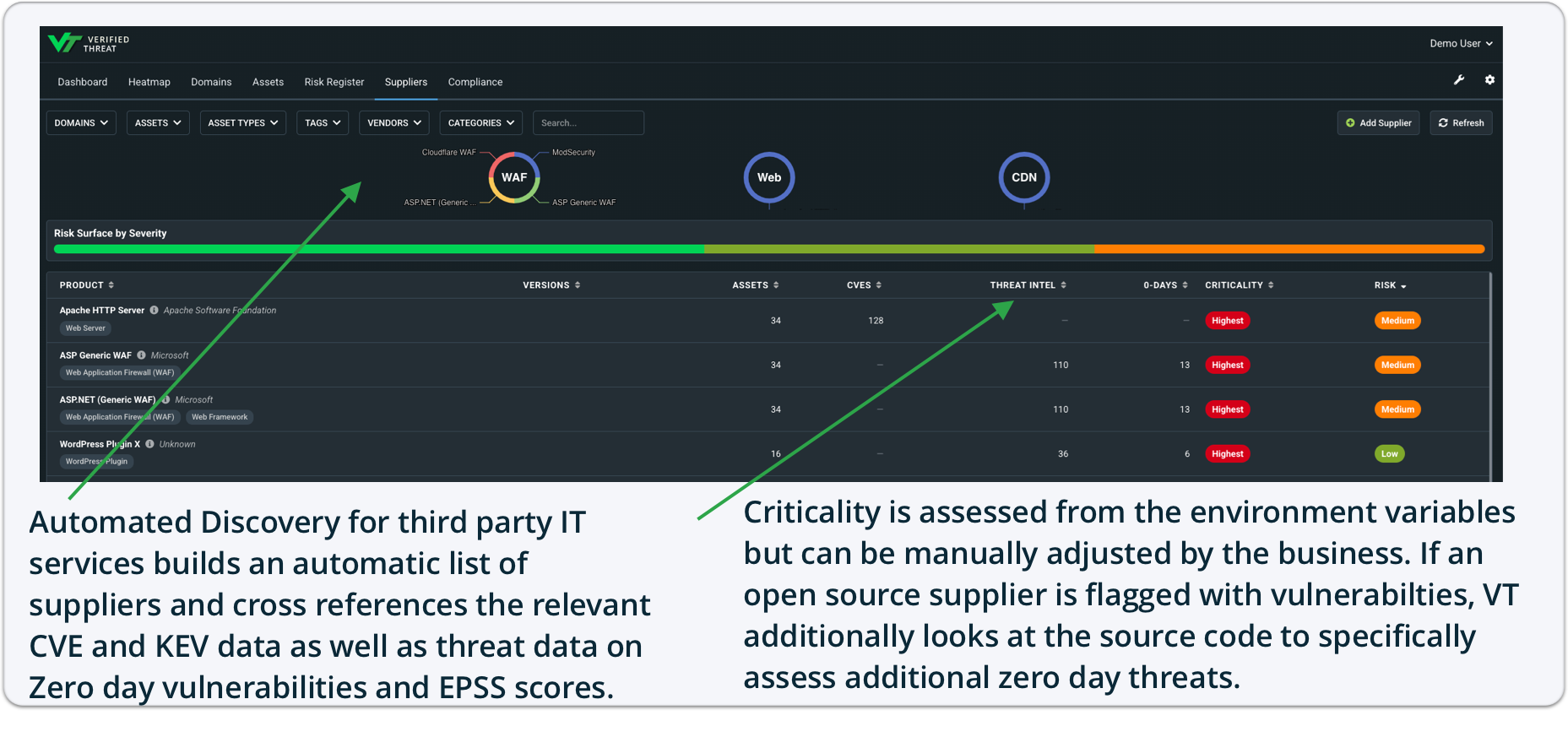
In the screenshot above you can see each supplier asset has the CVE’s, KEVs, threat intelligence, criticality score, and the total risk by asset area, so you can see all the relevant enriched data, and make an immediate assessment of the priority to the business.
Example:
- Zero day source code on open source software
- VerifiedThreat agents identify affected web server versions on three internet-facing hosts.
- Exploit code detected.
- Active exploitation campaign observed.
- Assets support a critical customer application.
- Risk escalated automatically to emergency remediation.
- Risk Owners informed
- Risk Register entries automatically generated
- The human in the loop then decides on how to deal with the risk.
This produces the actionable intelligence sequence required by Annex A 5.7 with the evidential proof that true operational change has occurred to systematically reduce the risk.
Implement Continual Vulnerability Testing
Implementing Verified Threat takes organisations from periodic scanning to continual exposure management.
Continuous testing model
Orchestrated agents test according to the changing threat intelligence, asset criticality, and the overall risk.
- At risk internet-facing assets are assessed at least once per day.
- Internal critical assets according to the risk but typically weekly.
- On every major infrastructure change.
- On every application deployment.
- Immediately after new critical vulnerability disclosure.
Include validation, not just detection
Continual testing should verify:
- Service reachability.
- Authentication exposure.
- Misconfiguration presence.
- Patch effectiveness.
- Security header implementation.
- TLS configuration.
- API authorization behavior.
- Access control enforcement.
Evidence-based validation reduces false positives and strengthens audit defensibility.
Validate Exploitability Instead of Counting Vulnerabilities
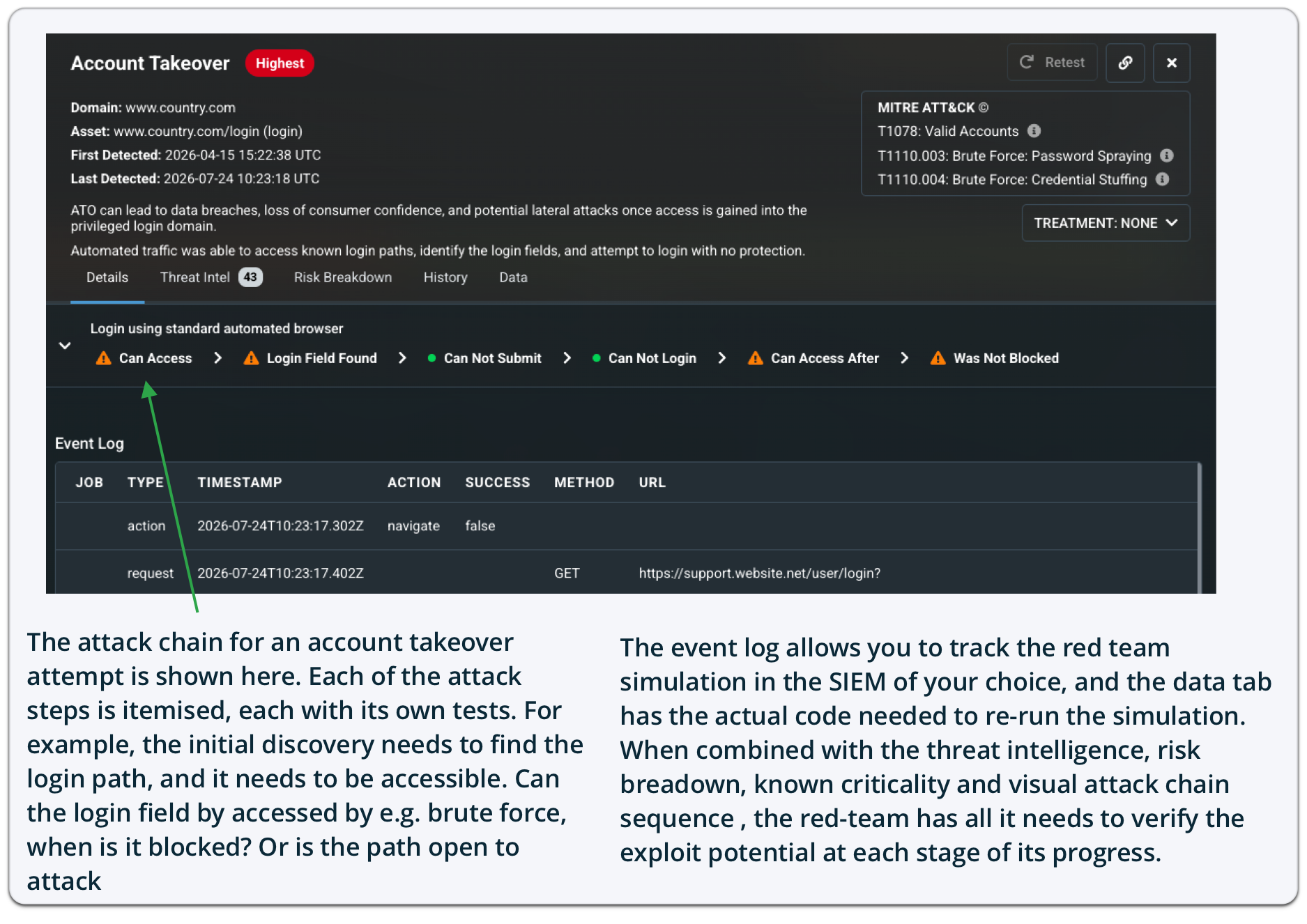
Annex A 5.7 focuses on the applicability of the threat intelligence, not on the vulnerability counts themselves, or the number of patches.The key to this is to verify the existence of the vulnerability. VerifiedThreat makes it this much easier - as we’ve been the platform to expressly show the exact chain and sequence of events, with the actual code needed to replicate the vulnerability. Show below is a typical example of an attack chain for account take over, showing each stage of the ATO attack, along with the code and logs necessary to re-create or understand the vulnerability fully. Typically any threat intelligence and the MITRE ATT&ACK framework reference are also included, so that you have all the details to validate the exploitability in one place.
Exploitability assessment criteria
Prioritize findings using:
A medium CVSS vulnerability on a public API with active exploitation may deserve higher priority than a high CVSS issue on an isolated internal system.
Integrate Threat Intelligence with Risk Management
Threat intelligence must feed the ISMS risk process. Here VerifiedThreat includes a risk register, which is automatically built with manual override to allow for fine granular control using tagging. For example, ensuring assets are tagged according to the appropriate ISMS risk owners, or threat management response functions ensures you have a seamless operational flow of data from the threat intel right through to active risk remediation and risk control.

Required linkage
For each significant intelligence item show in red on the screenshot you can now:
Identify affected assets along with the custom tagging by risk owner or other ISMS driven grouping.
Determine threat scenario.
Assess likelihood.
Assess business impact and adjust the criticality of the asset.
Update risk register if required.
Define treatment action.
Track remediation to closure.
Maintain evidence showing the connection between intelligence events and risk treatment decisions, along with clear reporting by e.g. risk owners.
Automate Operational Response
Actionable intelligence should trigger operational workflows automatically.
Recommended integrations
- ITSM ticket creation.
- SIEM detection rule updates.
- EDR watchlist updates.
- Firewall blocklist updates.
- Vulnerability remediation assignments.
- Executive notifications for critical exposures.
- Incident response playbook activation.
Automation reduces mean time to remediate and demonstrates operational use of intelligence.
Produce Audit-Ready Evidence
Auditors always need objective evidence. The interview stage does allow for a more nuanced approach - but unless you can back up the policy with evidence, it's going to result in a non conformity.
VerifiedThreat gives you the operational evidence you need to show how you’ve applied the incoming threat intelligence into your digital footprint.
VerifiedThreat Operational evidence
- Intelligence feed inventory mapped by Mitre ATT&CK framework.
- Asset Registry
- Vulnerability validation reports.
- Risk Register tagged by business risk owner or whatever is appropriate per the ISMS
- Risk Treatment by the risk owners
- Escalation records
VerifiedThreat Dashboards / Effectiveness evidence
VerifiedThreat takes these operational metrics and rolls them up into custom dashboards to measure overall operational effectiveness including OKR frameworks. For example,
- KRI dashboards.
- Trend reports.
- Risk reduction metrics.
- Control review outcomes.
- Daily / Weekly / Monthly reporting
ISMS Governance evidence
In turn these dashboards are used in conjunction with the ISMS to show overall continuous improvement and feed back into the document cycle. They can power the monthly risk reviews, and can then be used to drive further improvements in organisational controls over risk.
- Risk Policy
- Threat intelligence policy.
- Roles and responsibilities.
- Review meeting minutes.
Evidence will need to be retained according to the ISMS retention schedule.
Measure Effectiveness with Security Intelligence KPIs
VerifiedThreat uses customisable Key Risk Indicators (KRIs) to demonstrate continual improvement in the cybersecurity metrics. These KRIs can be easily adopted into an OKR (Objectives and Key Results) framework to measure key results and objectives over time.

Recommended metrics
Establishing the core metrics so you can establish Objectives and Key Results (OKRs) which are included in the management reporting for the ISMS is vital to achieving a mature process for continual improvement. It shows the auditor you have a mature understanding of the standard, and have built an understanding of continual improvement towards systematic risk reduction.
Practical 30-Day Implementation Plan
Days 1–5: Governance
- Approve threat intelligence policy.
- Assign owners.
- Define reporting lines.
Days 6–10: Asset Discovery
- Enumerate external assets.
- Validate ownership.
- Classify critical systems.
Days 11–15: Intelligence Collection
- Connect external feeds.
- Integrate internal telemetry.
- Define intake workflow.
Days 16–20: AI Correlation
- Configure enrichment rules.
- Map assets to technologies.
- Enable exploit intelligence checks.
Days 21–25: Continual Testing
- Schedule continuous external testing.
- Enable deployment-triggered scans.
- Configure evidence capture.
Days 26–30: Reporting
- Build dashboards.
- Define KPIs.
- Produce initial compliance report.
This phased approach delivers rapid operational capability without waiting for a large transformation program.
Common Compliance Failures to Avoid
Treating threat intelligence as a document repository
Intelligence must drive action across the organisation. Too often the threat intel remains siloed in the organization. You need to actively show how the threat intelligence is driving action.
Getting trapped by manual reporting
Spreadsheet driven risk registers are a nightmare to update and maintain. It's where data goes to die. VerifiedThreat has a risk register with an API that can be used to dynamically update into a database. This will
save huge amounts of time.
Scanning only with no owner
Too often scanning focuses just on known vulnerabilities - while the attackers are constantly trying to exploit new vulnerabilities. Focusing on just the known issues, while ignoring the risk owner will inevitably lead to gaps in your security.You need to move from traditional scanning to continuous assessment.
Measuring only vulnerability counts
Exploitability and business context matters much more than how many patches you achieved last week
Ignoring entire Asset Classes
Attack surfaces extend beyond the platform footprint. Use the threat intel to expand the scope.
Failing to review intelligence effectiveness
One of the core principals of the ISO 27001 framework is continual improvement. This is hard to do unless you have a mature process that has baselined risk, understands the total threat environment, measures it with reference to a known attack framework, and then have continual assessment to show actual progress to effective risk reduction. This needs to be reflected in the management reports and evidenced as you next define the company’s overall risk appetite.
Retaining no evidence of risk remediation
Auditors require traceability from intelligence to treatment. If it’s not documented, it simply doesn’t exist in the auditors world.
Example Compliance Workflow
Scenario: Critical authentication bypass vulnerability disclosed.
Automated workflow
- Threat feed ingested.
- AI identifies affected software versions.
- External testing confirms exposure on two hosts.
- Exploit code availability confirmed.
- Business criticality is determined as high.
- Emergency ticket created automatically.
- SOC alerted.
- Temporary WAF rule deployed.
- Patch applied.
- Retest confirms remediation.
- Risk register updated.
- Evidence stored in ISMS repository.
This end-to-end workflow demonstrates collection, analysis, actionable intelligence, response, and continual improvement.
Aligning with Other ISO 27001 Controls
Annex A 5.7 works most effectively when integrated with:
- 5.9 Inventory of information and other associated assets
- 5.24 Information security incident management planning and preparation
- 5.25 Assessment and decision on information security events
- 5.26 Response to information security incidents
- 8.8 Management of technical vulnerabilities
- 8.16 Monitoring activities
- 8.23 Web filtering
- 8.28 Secure coding
Cross-control linkage strengthens the overall ISMS and simplifies audit discussions.
Conclusion
Effective compliance with ISO 27001:2022 Annex A Control 5.7 requires a continuously operating threat intelligence capability that identifies, validates, prioritizes, and operationalizes security threats. VerifiedThreat’s continual vulnerability testing transforms static vulnerability management into an evidence-driven intelligence process by correlating asset exposure, exploit availability, business criticality, and active threat activity in near real time.
Organizations that implement governance, comprehensive asset intelligence, continuous testing, exploitability validation, automated response workflows, and measurable effectiveness metrics can demonstrate not only formal compliance with ISO 27001 Annex A 5.7 but also a materially stronger security posture and faster risk reduction across their digital estate.
FAQ
What does ISO 27001:2022 Annex A Control 5.7 require?
It requires organizations to collect, analyze, and use information about information security threats to produce actionable intelligence that supports risk treatment and security operations.
Is a commercial threat feed enough for compliance?
No. Organizations must demonstrate analysis, contextualization, communication, and operational use of the intelligence.
How often should vulnerability testing occur?
Internet-facing assets should typically be tested daily or continuously, while internal critical assets should be tested at least weekly and after significant changes.
What is agentic AI continual vulnerability testing?
It is an automated capability that continuously discovers assets, tests for vulnerabilities, validates exposure, correlates threat intelligence, and prioritizes remediation actions with minimal manual intervention.
How do we prove compliance during an audit?
Provide policies, asset inventories, intelligence reports, vulnerability validation evidence, remediation records, risk register updates, dashboards, and management review records.
Which metric is most important?
Mean time to remediate verified critical exposures is usually the strongest indicator of operational effectiveness.
Does Annex A 5.7 apply to cloud environments?
Yes. Cloud services, SaaS platforms, APIs, containers, and other cloud-native assets are part of the organizational threat landscape and should be included in the intelligence process.





.svg)
.svg)