
.svg)
.svg)


Verify Exploitability
Verify exploitability is the process of confirming whether a discovered vulnerability can actually be exploited in a specific environment, by a realistic attacker, under current conditions.
Security teams routinely receive vulnerability alerts from scanners, penetration tests, bug bounty reports, and threat intelligence feeds.
The critical question is not whether a vulnerability exists, but whether it is exploitable in the target environment. Verifying exploitability separates theoretical exposure from demonstrable risk and enables accurate remediation prioritisation.
VerifiedThreat’s has zero tolerance for unverified exploits. We show you exactly how VerifiedThreat works to provide evidential proof of the exact vulnerability, along with the code needed to reproduce the existence of the vulnerability.
For Vulnerability Prioritization see our article here:
Key Stages of Exploitability Verification
Why Exploitability Verification Matters
A traditional scanner may report thousands of vulnerabilities across an enterprise. Many are not exploitable because the service is disabled, access is restricted, compensating controls exist, or the vulnerable code path is unreachable. Remediating every finding equally wastes operational effort. Often the scanners will produce a risk rating based on the findings. For example, the overall risk could be deemed high, because the scanner has found patching issues. The business knows about the patching - it has a dependency on a large-scale migration on its tech stack, and is managing the legacy debt with compensating controls that have been put in place precisely to mitigate the risk. The scanner just reports on the versions - and doesn’t understand the risk context.
If your only tool is a hammer, sooner or later all you do is hit nails.
VerifiedThreat’s intelligent Agentic AI platform instead allows us to verifying exploitability so that you can:
- Focus on vulnerabilities that matter that are proven to be weaponisable.
- Reduce false positives.
- Align the business criticality with vulnerability risk
- Provide evidence to the purple team / IT team.
- Put in place a comprehensive risk based framework for prioritizing vulnerabilities.
Understanding Exploitability in Context
A vulnerability becomes exploitable only when technical and environmental conditions align. The VerifiedThreat agentic AI platform is orchestrated as a red team attack emulation, to try and use the same techniques an attacker would use to try and gain an attack advantage.
Tech Stack
The vulnerable software version, library, plugin, or component must actually be installed and active. This requires active discovery to ensure the components are accessible externally. Many security teams routinely disable headers and make it difficult to even establish the software versions remotely. It’s at this stage that false positives can easily creep in. VerifiedThreat has an API so you can easily verify the exact components with your existing assets databases. This allows you to simultaneously see the attack surface for what's actually running, and verify the data is correct from multiple sources, e.g. cloud asset managers, procurement database, existing asset data.
Reachability
An attacker must be able to reach the vulnerable interface through the network, application workflow, API endpoint, or local execution path.
Preconditions
Some vulnerabilities require authentication, specific privileges, user interaction, or a particular configuration state.
Feasibility
Public exploit code, known exploitation in the wild, or low-complexity attack conditions significantly increase exploitability.
A high CVSS score without reachability is often lower operational risk than a medium-scored vulnerability exposed directly to the internet. Don’t depend on someone else’s scoring metrics. It is vital to comprehensively map the criticality of the assets against the possibility of exposure.
Step 1: Discover and Confirm the Asset Criticality and Registry:
VerifiedThreat has an autodiscovery asset module, which uses intelligent Agentic AI agents to perform the initial discovery and compile an asset registry. The discovery process shown in the screenshot below is launched to automatically discover the externally facing assets. At this point VerifiedThreat makes inferences about the actual criticality of those assets. For example, servers, payment gateways, exposed admin & login panels will score higher automatically. Once the asset list is compiled, the risk vulnerability is matched against to provide an overall score. This still may not reflect the actual business risk. For this we use custom tagging as shown below.

Setting up custom tagging at the asset level allows companies to quickly and easily establish a critical asset registry according to the actual business priorities. The asset tagging cascades, so setting up one tag at the domain or asset level will cascade down, making the manual process much less laborious. Although the default settings can be utilised, customising the asset criticality gives much more customization, and allows you to focus on the assets that matter to the business.
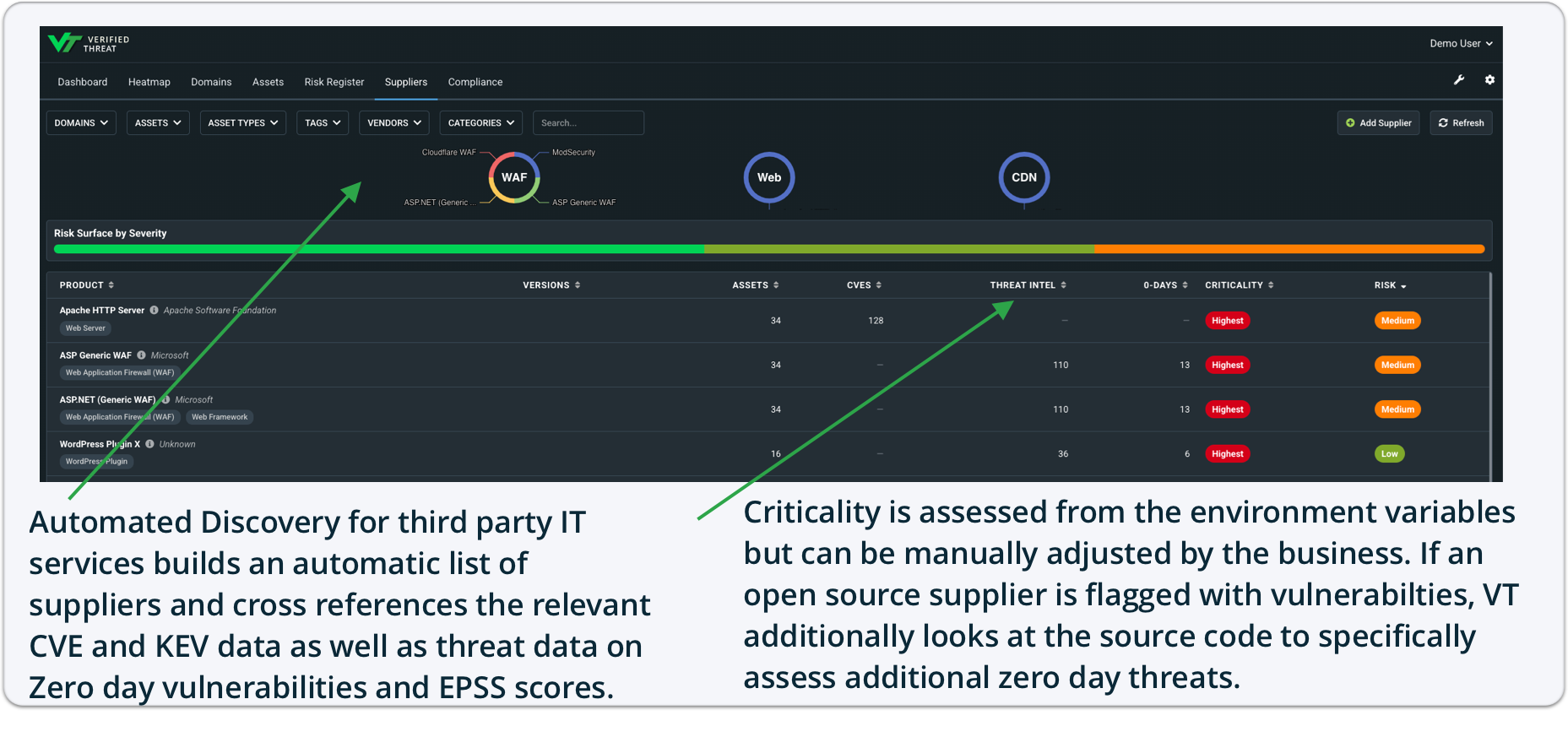
Third-party suppliers are also monitored automatically with the discovery process. This allows you to see any known vulnerabilities with CVE and KEV, but also look for any zero day vulnerabilities discovered by the real-time intelligence feeds.
Step 2: Validate Network Exposure
Next is to determine whether an attacker can reach the vulnerable service. This is where the VerifiedThreat agentic AI agents come into their own, and perform a continual red-team simulation of the external attack surface, looking for known vulnerabilities, as do the traditional scanners, but also constantly changing the attack vectors to probe for novel or new threats according to the latest threat intelligence.
External Exposure Checks
- Internet-facing DNS records.
- Open ports from external scanning.
- Load balancer exposure.
- CDN or WAF publishing status.
Internal Exposure Checks
- East-west network segmentation.
- VPN requirements.
- Firewall ACLs.
- Zero Trust access policies.
A vulnerable database listening only on localhost is materially different from the same database exposed on a public IP address.
Step 3: Confirm the Vulnerability Exists
Relying solely on scanner signatures produces a lot of false positive data. Instead of looking at known vulnerabilities, VerifiedThreat produces a detailed log of each vulnerability, along with the actual code so that it can be confirmed in the logs, and repeated under test conditions.

The VerifiedThreat validation methods clearly show the red-team simulation at each stage of the attack phase. You can see in the screenshot the exact sequence of spotting an account take-over attack, at which phase did the attack succeed, along with the exact code and the log file of the simulation. The threat intelligence on similar confirmed in-the-wild exploitations in included in the detail view, so the red-team has everything they need in one place.
Step 4: Analyse Exploit Preconditions
Identify what an attacker needs before exploitation is possible.
Exploit Preconditions
The more restrictive the preconditions, the lower the practical exploitability.
Step 5: Build an Attack Path
Exploitability is rarely a single-step event. Map how an attacker would realistically reach the vulnerable asset.
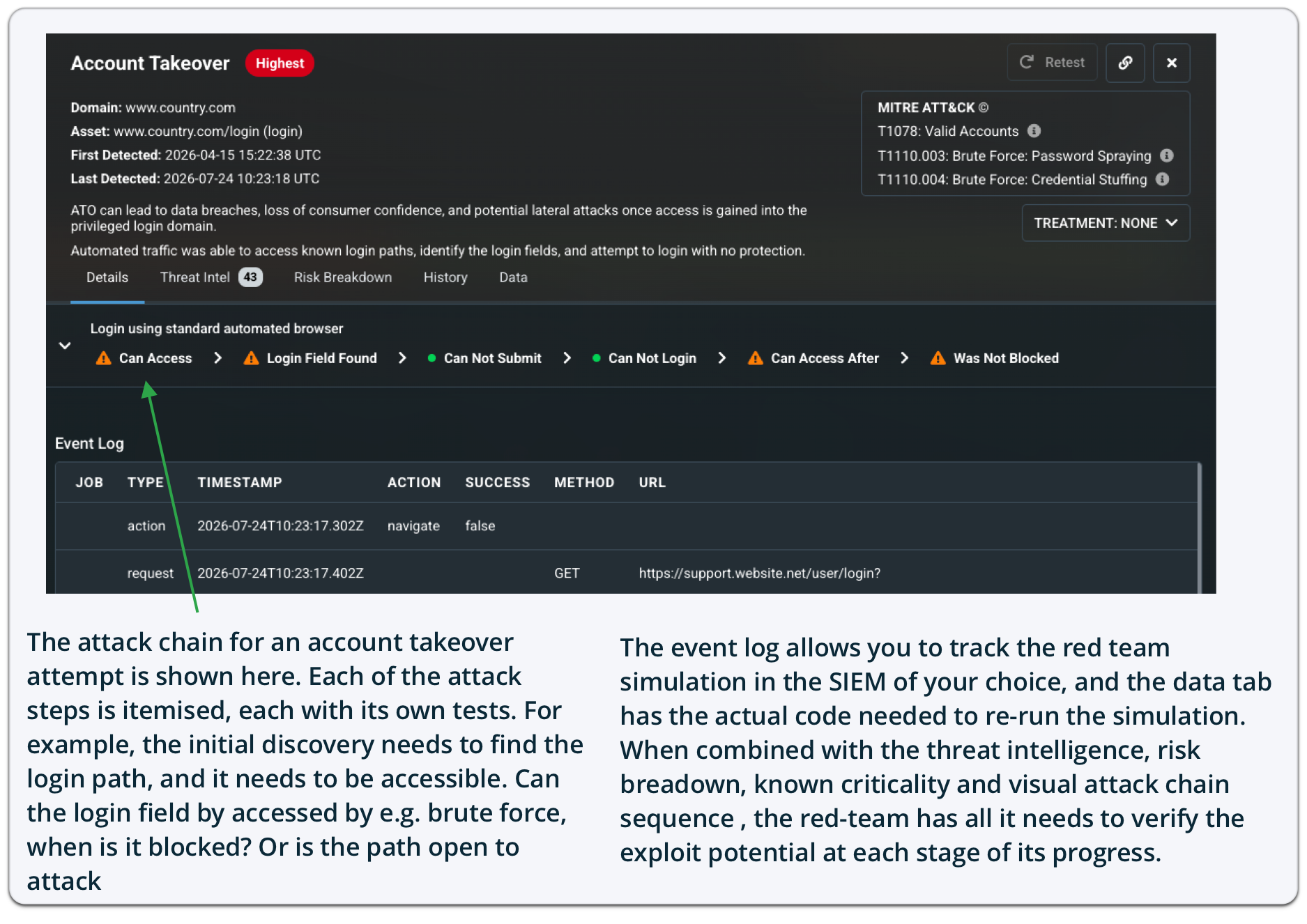
Example attack path for account take over:
- Is the login access path discoverable automatically?
- Are the Login fields found?
- Is automated traffic blocked on the path?
- An initial pair of credentials is tested
- Can the attacker submit credentials? At what stage are they blocked?
- Is MFA triggered?
- Combined with threat intelligence for known credential pairs, the red-team simulation can proceed to more advanced testing of the authenticated domain.
Attack path analysis often reveals that a "medium" vulnerability becomes critical when chained with weak identity controls.
Step 6: Safely Perform Red-Team Proof-of-Concept Testing
Controlled Red Team proof-of-concept (PoC) testing provides the strongest exploitability evidence.
Safe Testing Principles
- Use non-production systems whenever possible.
- Obtain written authorisation.
- Capture logs and timestamps.
- Avoid destructive payloads.
- Test the minimum conditions necessary.
Evidence to Collect
- Request and response pairs.
- Command output.
- Session identifiers.
- Screenshots.
- Packet captures.
- Log entries.
Successful exploitation should demonstrate the claimed condition, such as code execution, authentication bypass, privilege escalation, or data access.
Step 7: Verify Real Impact
A vulnerability may be exploitable but have limited impact. Confirm what can actually be achieved.
Assess:
- Data accessible.
- Privileges obtained.
- Persistence possibilities.
- Lateral movement opportunities.
- Business process disruption.
- Regulatory exposure.
Example:
A file read vulnerability in a container reveals only static assets and no secrets. Exploitability is confirmed, but impact is constrained.
Evidence-Based Exploitability Classification
Use a simple operational classification.
This taxonomy is easier for operations teams and executives to understand than e.g. raw CVSS metrics alone.
Incorporating Threat Intelligence
Exploitability changes rapidly when attackers begin using a vulnerability.
Prioritise findings that have:
- Public exploit code.
- Active exploitation reports.
- Ransomware association.
- Inclusion in CISA KEV or equivalent exploited-vulnerability catalogues.
- Metasploit modules.
- Commodity exploit kits.
A vulnerability with confirmed in-the-wild exploitation should be treated as urgent even if internal validation is still in progress.
Verifying Exploitability in Web Applications
For web applications, evaluate:
Input Reachability
Can untrusted input reach the vulnerable function?
Authentication Context
Can anonymous users access the endpoint?
WAF Effectiveness
Does the WAF block the exploit payload or merely log it?
Business Logic Constraints
Can workflow rules prevent exploitation?
Example:
An SQL injection finding in an admin-only endpoint may be significantly less exploitable than the same flaw in a public search function.
Verifying Exploitability in Cloud Environments
Cloud services require additional checks.
IAM Exposure
Can the vulnerable resource be reached with existing IAM permissions?
Network Security Groups
Are inbound rules restrictive?
Service Exposure
Is the service private, public, or conditionally exposed?
Metadata Access
Can exploitation lead to credential theft through instance metadata services?
Cross-Account Trust
Could exploitation enable access to other cloud accounts?
Cloud exploitability often depends more on identity architecture than on network exposure alone.
Common Mistakes When Verifying Exploitability
Avoiding these mistakes substantially improves assessment quality.
A Practical Exploitability Verification Checklist
Use this checklist during triage.
Remediation Validation
Verification is incomplete until the fix is confirmed.
After remediation:
- Re-scan the asset.
- Re-test the exploit path.
- Confirm patched versions.
- Validate configuration changes.
- Ensure compensating controls remain effective.
- Review logs for attempted exploitation.
A closed ticket without post-remediation validation is not verified risk reduction.
Metrics That Improve Vulnerability Operations
Using custom metrics around the actual business risk reduction that incorporate standard metrics such as Mean-Time-To-Detect (MTTD) and Mean-Time-To-Respond (MTTR) or remediate allows you to ensure you are covering the major Key Risk Indicators. Many organisations now choose to measure OKRs for cybersecurity with quarterly objectives and key results that can be shown in the risk meetings and kept track of to view the overall cybersecurity objectives and how they map into the overall company priorities.
These metrics provide a far more accurate view of security posture than total vulnerability counts.
Conclusion
Verifying exploitability transforms vulnerability management from a volume-driven activity into an evidence-driven risk discipline. By confirming asset presence, validating exposure, analysing preconditions, mapping attack paths, performing controlled proof-of-concept testing, and verifying real impact, VerifiedThreat can help identify which vulnerabilities matter most in our environment and display the prioritised data in custom dashboards for reporting.
Organisations that prioritise confirmed exploitability consistently reduce remediation workload, improve security outcomes, and focus resources on the weaknesses attackers can actually use.





.svg)
.svg)