
.svg)
.svg)


External Vulnerability Supplier Agent Monitoring
Why you need to move towards an intelligent context sensitive risk assessment and stop relying on static threat data.
Only 9% of organizations actively monitor and manage cybersecurity risks across their full supplier network—yet nearly 70% have suffered a cyber incident traced back to a third party.
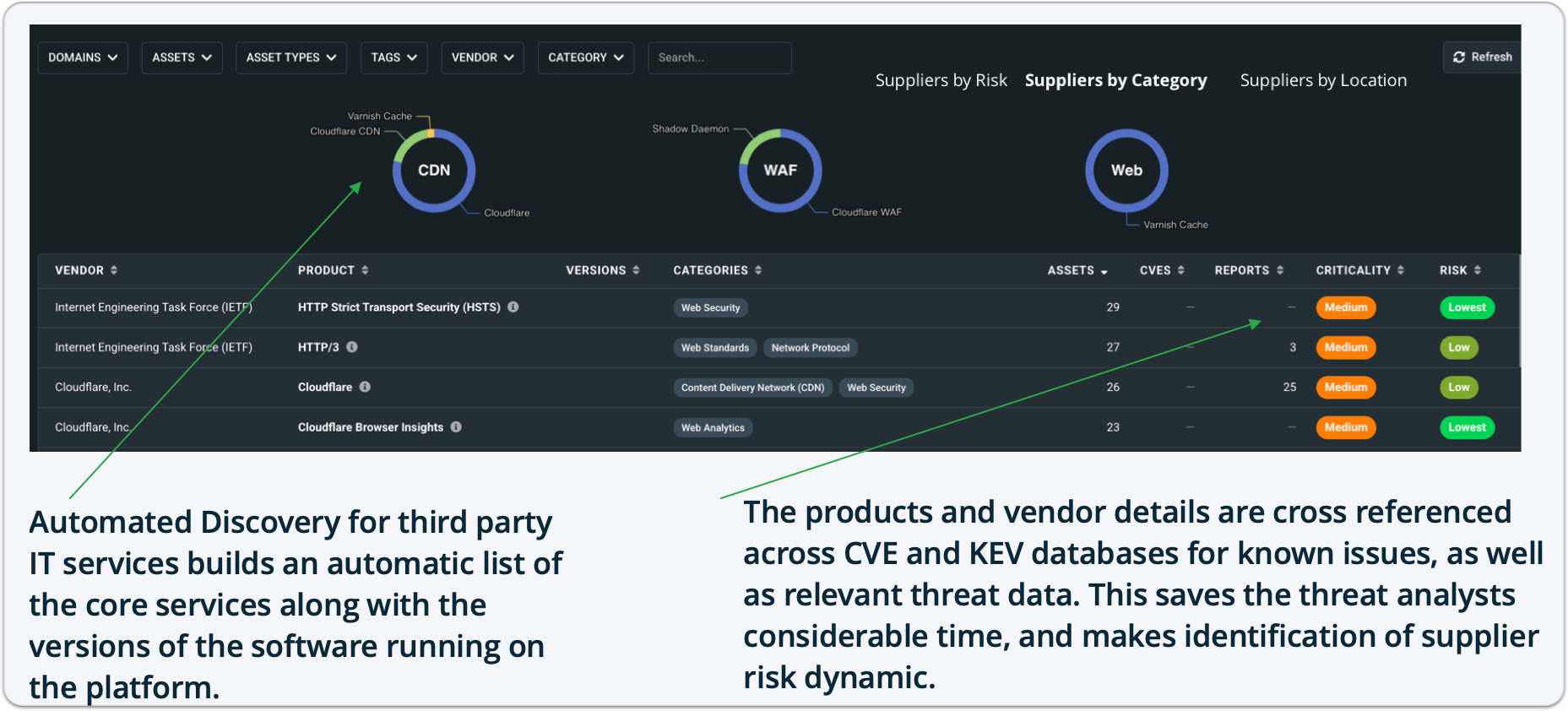
VerifiedThreat agents build a dynamic profile of the vendor ecosystem that’s actually deployed using active discovery and proprietary algorithms. Each supplier is cross-referenced with active threat and risk databases to generate an intelligent, context-sensitive risk topography that runs continuously to gain real-time insight into weaknesses that attackers could potentially exploit - before the attackers have a chance.
VerifiedThreat offers the following benefits over static playbooks:
Continuous Exposure Management - Agentic AI agents enable more accurate risk assessments and remediation recommendations at machine speed.
Integrated Threat Intel - VerifiedThreat identifies emerging risks before vulnerabilities become actively exploited by incorporating the latest threat data into our agents, and continuously looking for vulnerabilities using the dynamic agents so you can get ahead of attacks.
Reduces Asset Sprawl - ensures the actual platforms and services in use are discovered and protected, and can be easily integrated into your existing asset ledger and procurement systems via our API.
Vulnerability Prioritization Strategies
Effective monitoring is not merely about discovering vulnerabilities. It is about identifying which vulnerabilities require immediate attention. VerifiedThreat has over 12,000 agents which work intelligently to understand the underlying threat landscape, and the specific threats to your infrastructure, by business criticality and priority, all organised by custom Key Risk Indicators for your management dashboards.
Understanding External Vulnerability Agent Monitoring
In this blog we will look at external vulnerability agent monitoring, and how it improves cybersecurity through continuous attack surface visibility, automated risk detection, vulnerability management, and proactive threat reduction. We will explore best practices, workflows, and implementation strategies to incorporate outside-in agents with your existing software inventory databases, procurement sources of data, and assets registers.
External vulnerability agent monitoring is defined as the continuous observation, assessment, and reporting of vulnerabilities that exist across externally accessible assets. By deploying specialized monitoring agents and automated scanning technologies, organizations gain real-time insight into weaknesses that attackers could potentially exploit.
Unlike traditional periodic vulnerability assessments, continuous monitoring provides persistent visibility into evolving threats, newly discovered vulnerabilities, configuration changes, exposed services, and attack surface expansion. This enables security teams to identify risks before they become exploitable entry points, and ensures your team is monitoring the actual risks - and not relying on outdated supplier data.
It’s only too easy to perform a roll-back of services - either by accident or design and not to take into account vulnerabilities in prior software versions. It’s also very common for organizations to have purchased the latest versions, but not deployed them, and failed to comprehensively deprecate older versions. VerifiedThreat bridges this gap - which hackers exploit again and again, to ensure continual monitoring of the actual attack surface, and consolidated control over the asset register.
VerifiedThreat identifies emerging risks before vulnerabilities become actively exploited by incorporating the latest threat data into our agents, and continuously looking for vulnerabilities using the dynamic agents.
Why External Vulnerability Monitoring Matters
Cybercriminals increasingly target publicly exposed assets because they represent the easiest path into organizational networks. Every internet-facing application, server, API, cloud workload, VPN gateway, and web service creates a potential attack vector.
Organizations often struggle with:
- Legacy debt and patch dependencies
- The massive increase in threat data
- Shadow IT discovery
- Unmanaged internet-facing assets
- Unknown cloud deployments
- Misconfigured services
- Unpatched vulnerabilities
- Exposed credentials
- Third-party risks
- Rapidly changing attack surfaces
External vulnerability agent monitoring addresses these challenges through continuous asset discovery and risk assessment.
The result is a significantly improved security posture and reduced attack exposure.
Core Components of VT's External Vulnerability Agent Monitoring
VerifiedThreat serves as a powerful multiplier - giving immediate insight into the specific threats from the latest threat intelligence in the actual operating environment of the client, with empirical evidence of vulnerabilities, across the entire attack surface area and supply chain.
Asset Discovery
Security begins with visibility.
Organizations must identify every internet-accessible asset, including:
- Domains
- Subdomains
- IP addresses
- Cloud resources
- APIs
- Web applications
- Email infrastructure
- SSL certificates
- Remote access systems
Continuous discovery ensures newly exposed assets are immediately identified and assessed. It’s not enough to merely identify the asset. The VerifiedThreat context sensitive agents also provide context sensitive data on the actual asset criticality to determine the overall risk.
Vulnerability Detection
VerifiedThreat Monitoring agents continuously evaluate assets against critical risk as well as known vulnerability databases and threat intelligence sources .
Common vulnerability categories include:
- How critical is the asset?
- CVE (Common Vulnerabilities and Exposures) database
- KEV (Known Exploited Vulnerabilities) database
- Operating system vulnerabilities
- Web application flaws
- Remote code execution vulnerabilities
- Authentication weaknesses
- Privilege escalation risks
- Cryptographic issues
- Security misconfigurations
Automated detection significantly reduces the time between vulnerability disclosure and remediation.
Threat Intelligence Integration
Modern monitoring solutions correlate vulnerability data with:
- The underlying criticality of the asset
- Active exploit campaigns
- Threat actor activity
- Malware trends
- Zero-day intelligence
- Exploit availability
This allows security teams to prioritize vulnerabilities based on real-world exploitation risk.
Continuous Risk Scoring
Not all vulnerabilities carry equal risk.
VerifiedThreat calculates dynamic risk scores based on:
- Actual vulnerabilities proven by the agentic AI agents.
- Asset criticality and business impact
- Mean Time To Respond (MTTR)
- CVSS ratings
- Exploit maturity
- Internet exposure
- Environmental context
This dynamic prioritization enables efficient remediation efforts.
How External Vulnerability Agents Improve Security Operations
Real-Time Visibility
Traditional annual or quarterly scans leave large visibility gaps.
Continuous monitoring agents provide:
- Immediate vulnerability detection
- Exposure change tracking
- New asset identification
- Active risk monitoring
Organizations can react to threats as they emerge rather than after attackers discover them.
Faster Incident Prevention
Many successful cyberattacks exploit vulnerabilities that were known but not remediated.
VerifiedThreat’s External vulnerability monitoring reduces:
- Mean time to detect (MTTD)
- Mean time to respond (MTTR)
- Vulnerability exposure windows
This dramatically decreases the likelihood of compromise.
Improved Security Team Efficiency
Security teams frequently face working in business silos, and have to liaise with many business units over risk.
Automated monitoring systems help by:
- Prioritizing critical risks
- Eliminating duplicate findings
- Automating reporting
- Supporting remediation workflows
This enables teams to focus on high-impact security improvements for the entire enterprise.
Vulnerability Prioritization Strategies
Effective monitoring is not merely about discovering vulnerabilities. It is about identifying which vulnerabilities require immediate attention.VerifiedThreat has over 12,000 agents which work intelligently to understand the underlying threat landscape, and the specific threats to your infrastructure, by business criticality and priority. VerifiedThreat allows you to focus on the KRIs (Key Risk Indicators) for these critical vulnerabilities, so you can maintain accountability and ensure your organisations reporting is focused on what matters, and is showing incremental improvements over each period.
Organizations should prioritize based on:
Exploit Availability
Vulnerabilities with publicly available exploits present elevated risk.
Security teams should prioritize:
- Active exploitation
- Weaponized exploits
- Ransomware-associated vulnerabilities
Asset Criticality
Critical business systems deserve higher remediation priority than non-essential assets.
Examples include:
- Payment platforms
- Customer portals
- Authentication services
- Healthcare systems
- Financial databases
While VerifiedThreat’s agents are able to make predictive assumptions regarding the value of these assets, we also have a very efficient tagging process, which allows our customers to quickly identify and tag the appropriate business risk, which may otherwise not be fully realised with an automated discovery process only.
Internet Exposure
Externally accessible vulnerabilities represent higher risk than internal-only weaknesses.
Monitoring agents continuously evaluate exposure levels to support prioritization.
Compliance Benefits of External Vulnerability Monitoring
Many regulatory frameworks require continuous vulnerability management.
VerifiedThreat support compliance with:
- ISO 27001
- NIST Cybersecurity Framework
- SOC 2
Continuous monitoring demonstrates ongoing due diligence and security governance.
Compliance benefits include:
- Audit readiness
- Documentation automation
- Risk reporting
- Vulnerability tracking
- Remediation evidence
Best Practices for External Vulnerability Agent Monitoring
Maintain Continuous Asset Discovery
Organizations cannot protect assets they do not know exist.
Continuous discovery should include:
- Cloud environments
- Third-party integrations
- Subsidiary domains
- Development environments
Automate Vulnerability Assessment
Automation ensures:
- Consistent coverage
- Faster detection
- Reduced manual effort
- Improved scalability
Integrate Threat Intelligence
Threat intelligence adds critical context to vulnerability findings.
Security teams gain better prioritization and response capabilities.
Establish Risk-Based Remediation
Not every vulnerability requires immediate remediation.
Focus first on:
- Critical vulnerabilities
- Actively exploited vulnerabilities
- Internet-facing exposures
- High-value assets
Measure Security Performance
Key performance indicators should include:
- Vulnerability remediation time
- Asset discovery rates
- Critical vulnerability counts
- Exposure reduction trends
- Compliance metrics
Common Challenges and Solutions
Asset Sprawl
Challenge:
Rapid growth creates unmanaged assets.
Solution:
VerifiedThreat provides continuous attack surface discovery and monitoring and can be integrated with your existing asset ledger data.
False Positives
Challenge:
Security teams waste resources investigating inaccurate findings.
Solution:
VerifiedThreat provides the actual data from the agents - so the potential vulnerability can be validated, recreated and fully understood.
Resource Constraints
Challenge:
Limited personnel struggle with vulnerability volumes.
Solution:
VerifiedThreat has automated agents, and has extensive prioritization, and workflow orchestration.
Cloud Complexity
Challenge:
Hybrid and multi-cloud environments increase visibility gaps.
Solution:
VerifiedThreat's external agents and integrated APIs allow yo to close the gap, integrated with cloud asset tools, on-premises and cloud data.
Conclusion
External vulnerability agent monitoring has evolved into a foundational cybersecurity capability. Continuous visibility into internet-facing assets enables organizations to discover vulnerabilities, prioritize risks, accelerate remediation, and reduce exposure to cyber threats.
By combining asset discovery, vulnerability detection, threat intelligence, risk prioritization, and continuous monitoring, organizations establish a proactive security posture capable of defending modern digital environments. As attack surfaces continue to expand, continuous external vulnerability monitoring using platforms such as VerifiedThreat remains one of the most effective strategies for identifying and mitigating cyber risk before it impacts business operations.





.svg)
.svg)