
.svg)
Unknown Unknowns in Cybersecurity: Discovering the Hidden Risks That Traditional Security Misses
Unknown unknowns in Cybersecurity are best defined as hidden exposures that represent the blind spots that evade security teams, bypass traditional monitoring, and often become the entry point for sophisticated attackers. The greatest organizational risks increasingly originate from the security weaknesses we do not know exist today.
It was the former U.S. Secretary of Defense Donald Rumsfeld who first popularized the "knowns and unknowns" framework during a 2002 Pentagon news briefing regarding the search for Iraqi weapons of mass destruction. Most people at the time didn’t have a clue what he was saying, and the framework appeared to be gibberish at best, and at worst covering up for the fact there were no weapons of mass destruction in Iraq.
Rumsfeld was merely using an established military intelligence framework for understanding risk that has now been adopted by cybersecurity professionals.
The Four Categories of Cybersecurity Knowledge
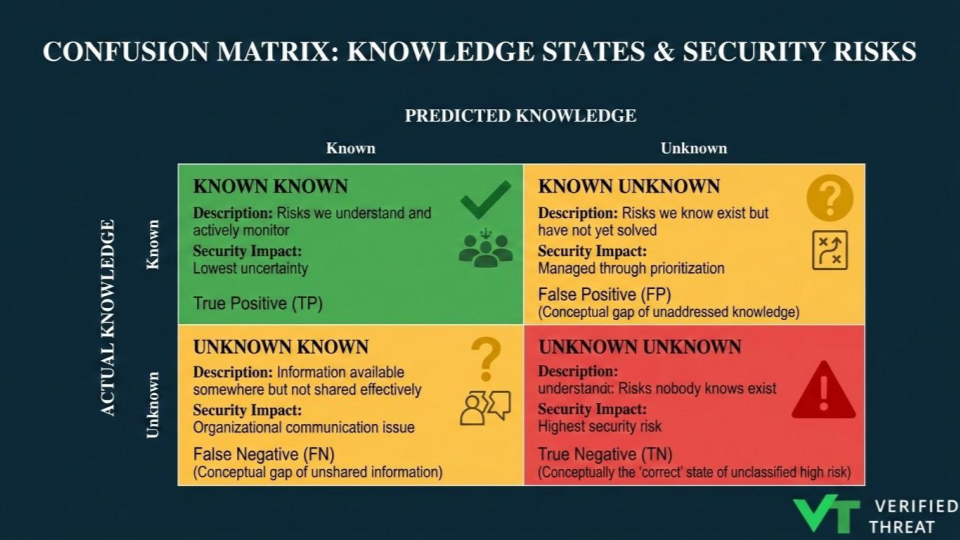
Risk Knowledge states can be categorized information into four distinct types as shown in the diagram used to display the results of machine learning.
- Known Knows: are risks we understand and actively monitor. This is the True Positive in Machine Learning terms. So for example, we’ve replaced our sequential account numbering with a GUID and introduced rigorous server side authorization, and access control lists to prevent an IDOR attack in our customer portal. We have mature stable defences, and ongoing monitoring to ensure such an attack cannot happen. Since the risk is understood and known, it's often an undocumented change in the environment variables, and CVE that’s not patched, an exposed testing platform, or a misconfiguration that the attackers can use to exploit known vulnerabilities. VerifiedThreat’s continual monitoring allows security teams to easily set up the appropriate monitoring for these True Positives.
- Known Unknows: are risks we know exist, but we don’t have perfect solutions for them. So for example we know attackers use phishing as a common method to gain unauthorized access, and we defend against this method of attack. We train our staff, introduce a range of email filtering, link sandboxing, DNS monitoring. However, the attackers are continually evolving the sophistication of the phishing attacks using e.g. GenAI and still some of the phishing attempts are successful. This is a False Positive. Cybersecurity platforms are riddled with these types of alerts, and this often leads to alerting fatigue and noise overload. Despite the false positives, we do know a real risk could occur, and are often reluctantly prepared to accept the noisy False Positives.
- Unknown Knows: are risks that should be known, but aren’t known to our organization. The information on this risk is available, but hasn’t been communicated effectively in the organization. This is a False Negative. These unknown knows should be the easiest to actually fix, using automated intelligent agents such as VerifiedThreat which are actively monitoring the latest threats and exploitation techniques.
- Unknown Unknows: are risks that no-one knows exists and that we don’t actively look for as we don’t have any data on the risk. Unknown unknowns represent the highest security risk. These are the true negatives. VerifiedThreat uses Machine Learning to assess these unknown cyber threats along with ingestion of the latest cyber intelligence threats. The intelligence agents continually assess the attack surface and continually seek to discover new vulnerabilities by varying the attack parameters constantly. Of course, even the agents can miss a potential threat that no-one knows exists. However, as the threat intelligence does quickly catalogue new risks and does find zero day exploits
Organizations invest heavily in firewalls, endpoint protection, vulnerability management, identity security, and threat intelligence. Yet despite these investments, successful breaches continue to occur because attackers frequently exploit assets, services, identities, and infrastructure that defenders never realized were exposed.
Understanding unknown unknowns is now essential for effective cyber resilience. As digital transformation accelerates through cloud adoption, SaaS platforms, APIs, remote work, third-party integrations, mergers, acquisitions, and shadow IT, the number of invisible security risks grows exponentially.
What Are Unknown Unknowns in Cybersecurity?
As we have seen unknown unknowns are security exposures that remain completely undiscovered by the organization. Unlike known vulnerabilities, they are absent from inventories, monitoring systems, risk registers, and security programs.
They represent assets, configurations, credentials, infrastructure, and attack paths that exist outside the organization's current awareness.
Examples include:
- Forgotten internet-facing servers
- Unknown cloud resources
- Expired but active DNS records
- Shadow IT applications
- Unmanaged SaaS accounts
- Exposed Admin Panels
- Exposed development environments
- Legacy VPN gateways
- Orphaned administrator accounts
- Public storage buckets
- Leaked API keys
- Third-party supplier exposures
- Abandoned Git repositories
- Forgotten test environments
Because defenders cannot protect assets they do not know exist, these exposures frequently become high-value attack vectors. VerifiedThreat has a continual set of over 12,000 agents that examine the external risk surface looking for these types of vulnerabilities.
Why Unknown Unknowns Continue to Increase
Modern enterprise environments change continuously.
Every new technology deployment introduces additional complexity:
- Cloud infrastructure
- Kubernetes clusters
- Containers
- Serverless applications
- APIs
- Remote endpoints
- Mobile devices
- IoT devices
- Operational Technology (OT)
- Multi-cloud environments
- Hybrid infrastructure
- DevOps pipelines
- Continuous deployment
Every deployment creates opportunities for forgotten resources.
Without continuous discovery, today's production environment quickly becomes tomorrow's hidden attack surface. With the rapid pace of business, mergers and acquisitions, private equity rollups and industry consolidation, the legacy debt increases massively, and the original staff who first architected and built the tech stack have long since moved on, along with all their domain expertise.
Unknown Unknowns Across the External Attack Surface
External Attack Surface Management (EASM) exists largely because organizations cannot manually track every internet-facing asset.
Examples include:
Forgotten Domains
Organizations often register hundreds of domains during marketing campaigns, acquisitions, or product launches.
Many remain active years later.
Attackers routinely identify:
- expired certificates
- vulnerable web applications
- abandoned login portals
- forgotten admin interfaces
Shadow Cloud Infrastructure
Developers frequently deploy cloud resources for testing.
These include:
- virtual machines
- object storage
- temporary databases
- API gateways
Once projects finish, these assets often remain publicly accessible.
Public Development Environments
Development servers commonly expose:
- debugging tools
- source code
- configuration files
- stack traces
- sensitive APIs
These environments frequently receive less security oversight than production systems.
Unknown APIs
Modern organizations expose hundreds or thousands of APIs.
Many remain undocumented.
Hidden APIs may expose:
- customer data
- authentication functions
- payment processing
- administrative operations
Attackers actively enumerate APIs because they often bypass traditional security testing.
Why Asset Inventories Become Inaccurate
Static asset inventories rapidly become outdated.
Changes occur daily through:
- employee onboarding
- contractor access
- Reliance on procurement records that don’t reflect the actual tech stack
- cloud deployments
- acquisitions
- software installations
- DNS updates
- infrastructure automation
- CI/CD pipelines
An inventory created even a month ago may already miss dozens of internet-facing assets.
Continuous discovery has therefore become more valuable than periodic inventories.
Unknown Unknowns Within Identity Security
Identity has become the primary attack vector for modern attackers.
Hidden identity risks include:
Dormant Administrator Accounts
Old administrative accounts frequently remain active after:
- employee departures
- contractor completion
- acquisitions
- system migrations
These accounts often retain elevated privileges.
Forgotten Service Accounts
Applications depend on service accounts.
Many are:
- never rotated
- poorly documented
- excessively privileged
Compromising one forgotten service account may provide complete domain access.
Legacy Authentication Systems
Organizations often operate:
- LDAP
- Active Directory
- Azure AD
- Entra ID
- Okta
- custom authentication systems
Legacy authentication platforms frequently remain connected long after migration.
Unknown Unknowns in Cloud Security
Cloud adoption significantly increases hidden exposure.
Unknown risks include:
- abandoned cloud accounts
- unused IAM roles
- excessive permissions
- public snapshots
- forgotten storage buckets
- exposed Kubernetes dashboards
- open security groups
- temporary credentials
- development subscriptions
Cloud infrastructure changes rapidly.
Manual discovery simply cannot keep pace.
Software Supply Chain Blind Spots
Organizations increasingly depend upon third-party software.
Unknown unknowns frequently originate from:
- open-source libraries
- package repositories
- software dependencies
- build pipelines
- CI/CD tools
- vendor integrations
Attackers increasingly target software supply chains because compromising one supplier can affect thousands of downstream organizations. VerifiedThreat’s supplier modules also actively target the supply chain vulnerabilities, looking for existing CVE, and looking at the latest threat intelligence for zero-day exploit discovery.
Hidden Risks Created by Shadow IT
Employees regularly introduce technology without security approval.
Examples include:
- personal cloud storage
- AI applications
- SaaS collaboration tools
- online databases
- automation platforms
- file sharing services
These platforms often store corporate information outside security monitoring.
Unknown Unknowns Created by Mergers and Acquisitions
Corporate acquisitions introduce hidden complexity.
Inherited infrastructure often includes:
- legacy websites
- forgotten VPNs
- unmanaged servers
- expired certificates
- unsupported applications
- undocumented networks
Many major breaches have originated from inherited infrastructure that escaped integration into enterprise security programs.
How Attackers Discover Unknown Unknowns
Attackers rarely begin with malware.
Instead, they begin with reconnaissance. Increasingly today the attackers use automated bot reconnaissance at massive scale to seek out and identify the sites with potential vulnerabilities.
Common discovery techniques include:
- Subdomain enumeration
- DNS analysis
- Certificate transparency searches
- Internet-wide scanning
- WHOIS analysis
- Search engine indexing
- Public Git repositories
- Cloud bucket enumeration
- API fingerprinting
- Metadata harvesting
- Email harvesting
- Technology fingerprinting
The objective is simple:
Find something defenders forgot.
Key Stages of External Vulnerability Scanning | Table
Strategies for Reducing Unknown Unknowns
Organizations that successfully minimize hidden cyber risk typically adopt several complementary practices:
- Continuous external attack surface discovery using platforms such as VerifiedThreat
- Automated asset inventory reconciliation
- Cloud security posture management
- Continuous vulnerability scanning
- Identity governance
- Privileged access management
- Certificate monitoring
- DNS monitoring
- Continuous threat intelligence
- Exposure validation
- Security automation
- Zero Trust architecture
- Continuous compliance monitoring
These practices transform invisible risk into measurable security intelligence.
Building a Continuous Exposure Management Program
Rather than relying on annual assessments, mature organizations continuously evaluate their security posture.
An effective exposure management program combines:
- External Attack Surface Management (EASM)
- Vulnerability Management
- Threat Intelligence
- Identity Security
- Cloud Security Posture Management (CSPM)
- Attack Path Analysis
- Continuous Threat Exposure Management (CTEM)
- Security Validation
- Security Operations (SOC)
Together, these capabilities reduce uncertainty and enable security teams to identify hidden risks before adversaries exploit them.
The Future of Unknown Unknown Detection
VerifiedThreat deploys Artificial intelligence, graph analytics, attack path modeling, and continuous security telemetry to transform cybersecurity from reactive defense to proactive exposure management.
Security programs are increasingly shifting away from periodic audits toward real-time visibility, enabling organizations to detect emerging assets, evolving attack paths, and previously unseen exposures as they appear.
Organizations that embrace continuous discovery, automated asset intelligence, and comprehensive exposure management significantly reduce the likelihood that hidden risks will remain invisible long enough to be exploited.
Conclusion
Unknown unknowns remain among the most dangerous challenges in modern cybersecurity because they exist outside traditional visibility. As organizations expand across cloud platforms, APIs, remote work environments, third-party ecosystems, and rapidly changing infrastructure, hidden assets and forgotten services become inevitable.
The most resilient organizations recognize that security is not only about protecting known systems but also about relentlessly discovering what has been overlooked. By combining continuous asset discovery, external vulnerability scanning, identity governance, cloud security monitoring, and threat intelligence, using VerifiedThreat, organizations can transform unknown unknowns into known, manageable risks—reducing their attack surface and strengthening their overall cyber resilience.
.svg)
.svg)