
.svg)
External Attack Surface Management in Cybersecurity
Many companies have seen their digital presence extending far beyond traditional corporate networks of the past. International acquisitions, rollup strategies, joint ventures and multi-channel relationships all extend the reach of the attack surface dramatically. The deals get the headlines, but the real hard work starts with understanding how to bring the operations back under control.
Acquisitions almost inevitably means that at least two entirely different tech stacks need to be managed from the security perspective. Inevitably, part of the rationale for the acquisition will be cost savings, but again, inevitably, key staff with specific sector knowledge often walk away. This means that even understanding which assets are in play and what is mission critical isn’t obvious. Typically, the security function will be centralised into one organisational unit, but will inevitably lose some of the expert sector knowledge needed to protect the assets in each stack. Legacy services are forgotten, and it's only too easy to leave test or uncompleted projects open to vulnerabilities. Discrepancies between the dev and operational platforms allow attackers to map backend architecture, test authentication flows, and exploit outdated software packages.Some of the largest ever cybersecurity attacks have come precisely from unhardened test platforms.
Cloud platforms, remote workforces, third-party services, APIs, mobile applications, forgotten subdomains, exposed S3 buckets, and rapidly changing internet infrastructure have dramatically expanded the number of assets attackers can target.
External Attack Surface Management (EASM) provides continuous visibility into every internet-facing asset associated with an organisation. Rather than relying on outdated inventories or periodic assessments, VerifiedThreat continuously identifies, classifies, monitors, and assesses external exposure from the same perspective as an attacker.
By discovering unknown assets before cybercriminals do, organisations gain the intelligence needed to reduce risk, strengthen security posture, and prevent breaches before exploitation occurs.
What Is External Attack Surface Management?
External Attack Surface Management (EASM) is the continuous process of discovering, inventorying, analysing, monitoring, and securing every internet-accessible asset that belongs to an organisation.
Unlike traditional vulnerability management, which focuses primarily on known internal systems, EASM identifies assets that may not even be documented within existing inventories.
These assets include:
- Public IP addresses
- Domains
- Subdomains
- Cloud infrastructure
- APIs
- VPN gateways
- Web applications
- Email servers
- Remote access portals
- Testing platforms
- IoT devices
- CDN endpoints
- Public repositories
- DNS records
- SaaS platforms
- Third-party service vulnerabilities
EASM continuously evaluates these assets for vulnerabilities, misconfigurations, outdated software, exposed services, leaked credentials, expired certificates, and other indicators that increase cyber risk. VerifiedThreat works with threat intel partners to ensure that its discovery process includes all the latest attack vectors and techniques.
Why External Attack Surface Management Matters
Attackers rarely begin by targeting protected internal networks.
Instead, they search for:
- Forgotten websites, subdomains or test environments
- Legacy applications
- Misconfigured cloud storage
- Open management interfaces
- Weak SSL configurations
- Publicly exposed APIs
- Default credentials
- Shadow IT
- Expired domains
- Vulnerable VPN appliances
Every exposed system represents another possible entry point.
As organisations rapidly adopt cloud services, acquisitions, remote work technologies, and third-party platforms, maintaining an accurate inventory manually becomes nearly impossible.
External Attack Surface Management solves this challenge through continuous automated discovery.
The Components of an External Attack Surface
An organisation's external attack surface includes every publicly accessible digital asset.
These typically include:
Domains and Subdomains
Corporate websites, regional portals, marketing domains, forgotten microsites, development environments and abandoned projects.
Cloud Infrastructure
- AWS
- Microsoft Azure
- Google Cloud Platform
- DigitalOcean
- Oracle Cloud
- Private cloud environments
Public IP Addresses
- Internet-facing servers
- Firewalls
- VPN gateways
- Remote desktop services
- Load balancers
- Application gateways
Web Applications
- Customer portals
- Employee portals
- Admin interfaces
- E-commerce platforms
- Support systems
- Knowledge bases
APIs
- REST APIs
- GraphQL APIs
- Partner integrations
- Mobile APIs
- Authentication services
Email Infrastructure
- Mail servers
- SPF
- DKIM
- DMARC
- SMTP gateways
- Exchange Online
DNS Infrastructure
- DNS records
- Zone transfers
- Dangling DNS
- Expired domains
- Subdomain takeover opportunities
Third-Party Services
- Content Delivery Networks
- Managed hosting
- External SaaS applications
- Payment gateways
- Identity providers
How External Attack Surface Management Works
Effective EASM combines continuous threat intelligence with discovery and automated security analysis. The VerifiedThreat follows the classic Gartner CTEM model.
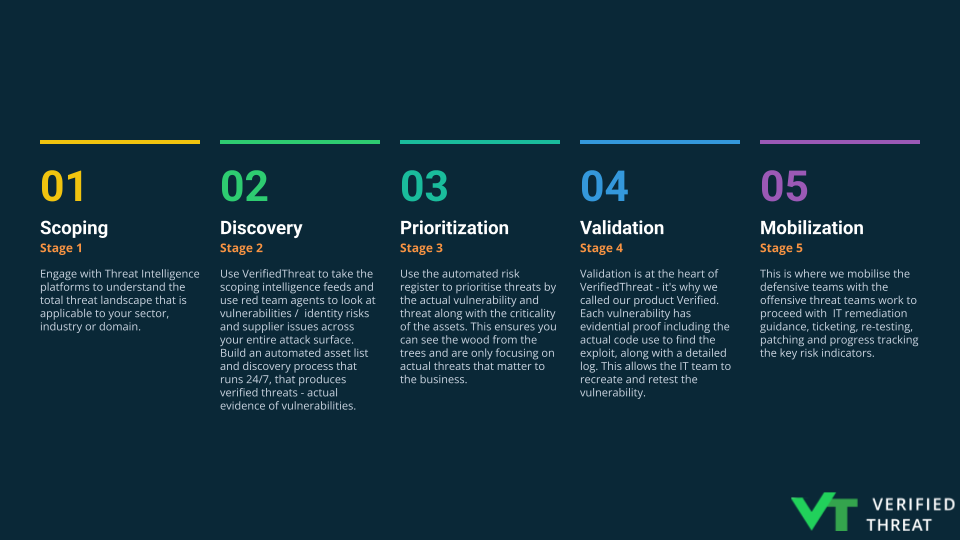
1. Scoping
Many organizations skip the scoping phase and move straight into discovery. VerifiedThreat places heavy emphasis on the scoping. If you don’t have a thorough understanding of the threat environment and the latest threat intelligence and how it can directly affect the risk profile, you’re going to miss the wood for the trees. Organizations have widely different risk appetites. It’s vital to understand the scope along with business risk appetite to ensure the best possible risk prevention for your organisation.
- Formal risk appetite policy.
- Threat Intelligence Integration inline with the risk appetite.
- Mapping threat intelligence to the Mitre Attack framework.
- Building a visual map of threats applicable across the entire attack surface by attack type.
- Testing each specific threat with intelligent agents that assess precisely the attack vectors common across your industry sector / domain.
- Third-party supply chain scope.
- Clear definitions for what is out of scope, that are clear, justified and documented accordingly.
The goal is to ensure that all the risk elements are thoroughly evaluated, and the scope fully understood and any out of scope risk are accounted and accepted according to the risk appetite of the organization
2. Continual Asset Discovery
VerifiedThreat has over 12,00 intelligent agents that continuously discover externally visible assets. Using a red team simulation approach tied to the threat intelligence, machine learning adaption helps to continually use different attack parameters and techniques that are dynamically adapted. This mimics the real-world hackers who will use the same techniques modified for each platform they attempt to gain access to. Typically the discovery process will attempt to first establish a definite asset list of what is actually running. Often this is in sharp- contrast to the lists from procurement or other outdated asset lists that are maintained in spreadsheets that are instantly out-of-date.
- Continual coverage ensures that the key performance indicators such as Mean-time to Discovery and Mean-Time-to-Remediate can be easily tracked.
- Servers, API’s, login paths, admin portals, exposed email servers
- Domain and subdomain mapping / port scanning
- User enumeration
- Supply chain discovery, matched against CVE’s, zero day intel
- Mismatched configuration, exposed panels
- Certificate issues / weak SSL encryption.
The goal is to identify every digital asset regardless of whether internal IT teams are aware of its existence.This closely mimics an actual external hacker based attack.
3. Prioritisation
Each discovered asset is automatically categorized by the actual verified risk discovered by the agents as well as the induced criticality of the asset. The asset criticality is further enhanced by cascading tagging, which allows the business owners to easily tag discovered assets by a wide customisable list of parameters according to the risk appetite of the business. Prioritisation is further addressed by the inclusion of customisable Key Risk Indicators, that can be used to measure and baseline risk over time.
- VerifiedThreat shows the actual exposure threat in code, that can be reproduced to ensure zero false positives, and ensures the business can focus on relevant threats.This accurately measures ease of exploitation, the exact attack chains used and exposes the vulnerability.
- Business Ownership / Business function, so assets can be tagged by reporting / department in a user configurable way, that makes sense to the business and risk owners.
- Assets are then prioritized by the Technology stack - for example, by test environment, production, front-end, or back-end platforms, as well as the criticality of the asset.
- Third party suppliers, by CVE, mean-time-to-discovery, mean-time-to-remediate, and any relevant zero day threat data on suppliers.
- Criticality of the assets, enriched by customer tagging to ensure all assets are matched to the relevant risk appetite of the risk owners.
- Threat intelligence matches - see where we have known threats in your specific sector with a known vulnerability.
- Geographic location - relevant for sovereign state actors, compliance with relevant standards and frameworks, as well as geopolitical risks.
4. Validation
The validation stage is where VerifiedThreat comes into its own. Each and every threat is verified, with the actual code necessary to track the vulnerability in the logs, or reproduce the threat so it can be understood and remediated if necessary. Assets also undergo continuous assessment against known vulnerabilities such as:
- Third party CVEs, zero day intelligence on suppliers.
- Open ports, weak WAF rules,
- Weak encryption
- Misconfigured services
- Exposed databases
- Missing security headers
- Outdated software
- Public administration panels
- Default credentials
5. Mobilisation
Now the full process has been scoped, automatically discovered, prioritized and validated, the security team is now ready to focus on the remediations that matter, and engage the defensive team and IT team / dev ops teams into actually addressing the underlying security issues, retesting and validating the fixes. The accurate reporting allows the organization to see the progress of its key risk indicators over time, and hopefully to see meaningful reductions in the attack surface threats, as well as improved overall security.
Key Stages of External Vulnerability Scanning
Common Risks Identified Through EASM
VerifiedThreat’s External Attack Surface Management frequently uncovers:
- Insecure perimeter protection
- Account Take over Breaches
- Fake Account Creation and exploitation of protected accounts
- Remove Code Execution
- Shadow IT
- Cloud misconfigurations and orphaned assets.
- Development test and non-hardened environments
- Exposed repositories
- Public storage buckets
- Exposed Admin panes
- Weak SSL certificates
- Weak login paths
- Vulnerable VPN gateways
- Exposed RDP services
- Remote management interfaces
Benefits of External Attack Surface Management
Organisations implementing continuous EASM gain significant advantages.
Complete Visibility
Unknown assets become known assets.
Reduced Attack Surface
Unused services and forgotten infrastructure can be retired before exploitation.
Faster Vulnerability Detection
Critical vulnerabilities are identified within hours rather than months.
Improved Compliance
Continuous visibility supports ISO 27001, NIST CSF, CIS Controls, PCI DSS and other security frameworks.
Lower Business Risk
Security teams focus remediation on assets most likely to be exploited.
Enhanced Incident Prevention
Reducing exposed attack vectors lowers the likelihood of successful compromise.
External Attack Surface Management Best Practices
Successful EASM programmes should include:
- Continuous automated asset discovery
- Integration with threat intel to ensure adequate scoping
- Intelligent agent orchestration by business risk
- Complete external asset inventories
- Real-time vulnerability monitoring
- Key Risk Indicators that can be monitored over time
- Configurable Alerts and Reporting
- Cloud asset visibility
- API inventory management
- Third-party risk monitoring
- Continuous attack surface reduction
- Executive reporting
- Security validation
External Attack Surface Management vs Traditional Vulnerability Scanning
Integrating EASM into a Cybersecurity Strategy
External Attack Surface Management should complement—not replace—existing security practices. When integrated with Security Information and Event Management (SIEM), Security Orchestration, Automation and Response (SOAR), threat intelligence platforms, vulnerability management tools, and configuration management databases (CMDBs), EASM provides a unified view of external exposure.
Security teams can automate workflows that create tickets for newly discovered critical assets, trigger validation scans after remediation, and correlate external findings with internal telemetry. This integrated approach shortens response times and ensures that newly introduced internet-facing systems are quickly brought under governance.
Measuring the Success of an EASM Program
To evaluate the effectiveness of an External Attack Surface Management initiative, organisations should monitor measurable security outcomes rather than activity alone. VerifiedThreat allows organizations to set up customisable Key Risk Indicators, that provide a useful management overview of the actual core business risks, and their performance over-time.
Useful metrics include:
- Key Risk Indicators (KRIs)
- Total internet-facing assets discovered
- Percentage of previously unknown assets identified
- Core proven vulnerabilities that match the known threat intelligence
- Number of vulnerabilities by business risk over time
- Mean time to discover (MTTD) new external assets
- Mean time to remediate (MTTR) critical exposures
- Number of critical vulnerabilities exposed to the internet
- Reduction in shadow IT assets
- Percentage of assets with current security patches
- Number of expired or misconfigured certificates
- Reduction in exposed administrative interfaces
- Compliance against internal security baselines
Tracking these metrics over time demonstrates improvements in visibility, operational efficiency, and overall cyber resilience.
Conclusion
External Attack Surface Management has become a fundamental component of modern cybersecurity. VerifiedThreat, by continuously discovering external assets, analysing exposure, identifying vulnerabilities, prioritising risk, and monitoring for changes, enables organisations to reduce their attack surface proactively. Combined with robust vulnerability management, threat intelligence, and security operations, it provides a scalable framework for identifying and mitigating cyber risk before attackers can exploit exposed systems.
.svg)
.svg)