
.svg)
Offensive vs Defensive Cybersecurity: The Complete Guide to Modern Cyber Defense
The best sports teams in the world from football, to ice hockey and basketball have one thing in common. They switch seamlessly from defensive to offensive in the blink of an eye. Almost gone are the days of attacking forwards not tracking back, defending and actively pressing along with the entire team. On the other hand, simply relying on defence alone and “parking the bus”- is a sure fire way to effectively guarantee you will be subject to wave after wave of attacks.
In the same way modern organizations face an evolving cyber threat landscape where attackers continuously develop new techniques to compromise networks, applications, cloud infrastructure, identities, and critical business systems.
Protecting digital assets requires more than simply the defensive block check of deploying firewalls and antivirus software. Effective cybersecurity demands a balanced strategy that combines offensive cybersecurity techniques with comprehensive defensive cybersecurity operations into a new integrated platform that, just like the best sports teams, seamlessly switches between the two.
Rather than viewing offensive and defensive cybersecurity as competing disciplines, successful organizations need to integrate both into a continuous security improvement cycle. Offensive security identifies weaknesses before attackers exploit them, while defensive security detects, prevents, contains, and recovers from attacks.
So many security teams are doing the sports equivalent of parking the bus. They rely on defence and double down on the traditional defences, which in turn causes the hackers to launch wave after wave of attacks.
This comprehensive guide explores both disciplines in detail, explaining their methodologies, technologies, objectives, and, most importantly, shows how they can work together in a cohesive integrated whole to reduce organizational risk.
What Is Offensive Cybersecurity?
Offensive cybersecurity is the proactive practice of identifying, validating, and exploiting security weaknesses under controlled conditions before malicious actors can abuse them.
Security professionals simulate real-world attacks against systems, applications, cloud environments, APIs, wireless networks, and infrastructure to uncover vulnerabilities that traditional security controls may miss.
The ultimate objective is to think and operate like an attacker while maintaining strict authorization and ethical boundaries.
Common objectives include:
- Using threat intelligence to identify potential threats in your industry / sector
- Identifying exploitable vulnerabilities
- Validating security controls
- Measuring attack paths
- Testing incident response capabilities
- Discovering privilege escalation opportunities
- Evaluating cloud security posture
- Improving overall cyber resilience
Rather than assuming defenses are effective, offensive cybersecurity proves whether they actually withstand realistic attacks.
What Is Defensive Cybersecurity?
Defensive cybersecurity encompasses the technologies, processes, and people responsible for protecting systems against cyber threats.
Defensive teams continuously monitor infrastructure, detect suspicious activity, respond to incidents, investigate compromises, and improve security controls.
Their mission is to reduce the likelihood and impact of successful cyber attacks through layered security.
Core defensive responsibilities include:
- Threat detection
- Security monitoring
- Identity protection
- Vulnerability management
- Endpoint security
- Network security
- Email security
- Cloud security
- Data protection
- Incident response
- Digital forensics
- Disaster recovery
Defensive cybersecurity operates continuously, protecting organizations 24 hours a day.
Offensive vs Defensive Cybersecurity: Key Differences
The Offensive Security Lifecycle
Modern offensive security follows a structured methodology.
Reconnaissance
Gathering publicly available intelligence about the target.
Examples include:
- DNS records
- WHOIS information
- Employee profiles
- Technology stack
- Cloud assets
- GitHub repositories
- Social media intelligence
- Public infrastructure
Enumeration
Enumerating exposed systems and services.
Activities include:
- Port scanning
- Service discovery
- Banner grabbing
- API discovery
- SSL/TLS inspection
- Directory enumeration
- Subdomain discovery
Vulnerability Discovery
Security professionals identify weaknesses including:
- Missing patches
- Weak authentication
- Misconfigured cloud storage
- Exposed databases
- Weak encryption
- Default credentials
- Software flaws
- API vulnerabilities
Exploitation
Controlled exploitation demonstrates real-world business risk.
Examples include:
- SQL Injection
- Cross-site scripting
- Remote code execution
- Privilege escalation
- Authentication bypass
- Server-side request forgery
- Insecure deserialization
Post Exploitation
After initial access, testers evaluate how attackers could expand control.
Activities include:
- Credential harvesting
- Lateral movement
- Active Directory enumeration
- Persistence testing
- Data access validation
- Privilege escalation
Reporting and Remediation
Findings are documented with:
- Technical evidence
- Risk ratings
- Business impact
- Proof of concept
- Remediation guidance
- Executive summaries
Core Defensive Cybersecurity Functions
Security Operations Center (SOC)
The SOC continuously monitors infrastructure using SIEM platforms, endpoint detection systems, threat intelligence, and behavioral analytics.
Analysts investigate alerts and coordinate incident response.
Threat Detection
Defensive teams identify:
- Malware
- Insider threats
- Credential theft
- Ransomware
- Phishing attacks
- Lateral movement
- Data exfiltration
Incident Response
Once an attack is detected, responders:
- Identify affected systems
- Contain the incident
- Remove malicious artifacts
- Recover systems
- Document lessons learned
Endpoint Protection
Modern endpoint security combines:
- Antivirus
- EDR
- XDR
- Behavioral analysis
- Application control
- Device encryption
Identity Security
Identity protection includes:
- Multi-factor authentication
- Conditional access
- Privileged Access Management
- Single Sign-On
- Identity monitoring
Cloud Security
Organizations secure:
- AWS environments
- Microsoft Azure
- Google Cloud
- Kubernetes clusters
- Containers
- Serverless platforms
Offensive Security Techniques
Modern offensive teams perform numerous assessments.
Penetration Testing
Simulated attacks identify exploitable vulnerabilities.
Red Team Exercises
Advanced simulations emulate sophisticated adversaries over extended periods.
Purple Teaming
Red and Blue teams collaborate to improve defensive capabilities.
Adversary Emulation
Security teams replicate known threat actor tactics using threat intelligence.
Social Engineering
Authorized testing measures employee awareness against phishing and impersonation attacks.
Continuous Threat Exposure Management (CTEM)
VerifiedThreat uses thousands of intelligence agents combined with the latest threat intelligence, to provide continual vulnerability testing at massive scale. This approach ensures 24/7 protection coverage, and combines a red team approach with adversary emulations using intelligent agents that are programmed to constantly vary the attack approach and seek to bypass existing defences.
This gives the following benefits:
- Continual Coverage, not just periodic testing
- Combines red team attack simulations on your infrastructure
- Integrates threat intelligence for your sector or domain automatically, and maps out the existing general threats, versus the specific threats in your platforms.
- Enterprise authentication
Defensive Security Technologies
Organizations deploy multiple overlapping technologies.
These include:
- Next-generation firewalls
- Intrusion Detection Systems
- Intrusion Prevention Systems
- SIEM
- SOAR
- EDR
- XDR
- Network Detection and Response
- Web Application Firewalls
- Email Security Gateways
- Data Loss Prevention
- DNS Security
- Zero Trust Network Access
- Cloud Security Posture Management
External Vulnerability Scanning Stages
How Offensive and Defensive Security Work Together
We’ve seen how, just like in the best sports teams, the strongest cybersecurity programs integrate both offensive and defensive security to work together. Let’s look how this can be achieved in practice.
VerifiedThreat uses a Continuous Threat Exposure Management (CTEM) set of process steps as outlined by Gartner. This comprehensive five-stage framework enables organizations to pivot from reactive remediation - basically patch everything - towards a strategy anchored in business risk. By following a continuous loop of scoping, discovery, prioritization, validation, and mobilization, security teams can effectively manage their entire attack surface.
Many existing external scanning tools scan and find CVE’s and other vulnerabilities and then score the platform according to these findings. The IT team already knows it hasn’t patched because of an existing dependency and legacy debt that will take some considerable time to clear. The tool then flags this up. Since its only metric is the fact the CVE hasn’t been remediated, it then uses this to penalize the security score.
VerifiedTheat takes a completely different approach. Our continuous feedback loop steadily strengthens organizational resilience over time.
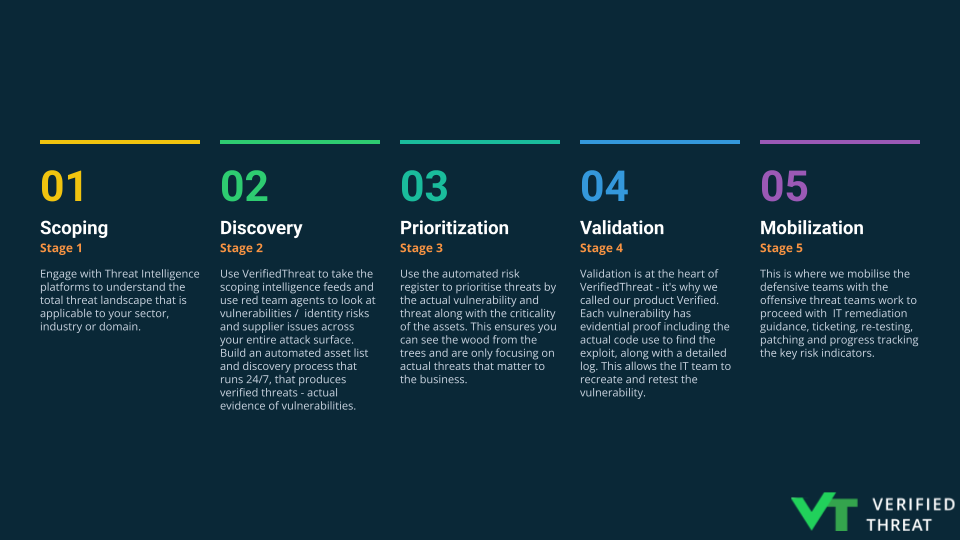
Scoping Stage: At the scoping stage, we first work with Threat intelligence providers such as Cyjax to review the complete threat landscape. This gives a continual feed of potential threats to your industry, geography or sector, by understanding the actual threat actors, their methods and likely future targets. It takes considerable time and in-depth security knowledge to understand each incoming threat, map that threat to a potential attack vector in your platform, and constantly keep track of the latest attacks. Inevitably the vast majority of potential threats never occur, but ignoring the scoping stage leads you wide open to the most common attack methods and methodologies, as well as specific threat data on your platform from the dark web.
Discovery: At the discovery stage, VerifiedThreat ingests the threat intelligence and matches it against the relevant Mitre Attack framework reference for all historical attacks. This allows then the intelligent agents to prioritise searching for known attack vectors using known methods, and searching for zero day attack opportunities. The discovery process then uses 12,000 AI agents that are orchestrated to examine the platform’s entire domain, including sub-domains, mapping, technology stack, and start to build out a central asset registry. The smart asset registry can then be tagged by the business according to the criticality of the asset. The tags cascade down, so each and every asset can be quickly identified and associated with a risk profile.
Prioritisation: At the prioritisation stage, VerifiedThreat uses the intelligent agent network to start testing each and every asset for vulnerabilities. Although this will pick up e.g. CVE data as regular scan would, the agents are orchestrated to go far beyond this, and will actively use red team techniques and use modified payloads to seek to bypass existing defences and probe for vulnerabilities across the entire external risk surface. The agents concentrate on the assets that have been discovered and tagged as important to the business, to ensure a consistent approach to prioritisation.
Validation: At the validation stage, VerifiedThreat comes into its own. VerifiedThreat has zero tolerance for false alerts. VerifiedThreat provides the evidential proof in the code of a vulnerability, or specifically maps out the attack chain to show how the assets are vulnerable. When combining a proven validation of a vulnerability, with the criticality assessment of the underlying asset, the actual business risk is then both prioritized and validated.
Mobilisation: Finally, once the validation stage is accepted, the IT team and the security team can mobilise to proceed with the actual work of remediation, retesting, and tracking down the key risk indicators, by order of business risk.
Benefits of Combining Offensive and Defensive Cybersecurity
Organizations achieve measurable improvements including:
- Mapping threat intel into proven vulnerabilities
- Understanding and measuring the total attack surface
- Faster vulnerability remediation
- Better visibility, and the ability to discover the true Key Risk Indicators
- Continual reporting
- Stronger regulatory compliance
- Improved incident response
- Lower breach likelihood
- Higher cyber resilience
- Better executive risk reporting
- Enhanced security maturity
- Continuous validation of security controls
Best Practices for a Balanced Cybersecurity Strategy
Organizations should adopt a continuous improvement model that includes:
- Regular penetration testing
- Continuous external vulnerability scanning
- Security awareness training
- Multi-factor authentication
- Vulnerability management
- Adopting a tool such as VerifiedThreat with Continuous threat exposure management (CTEM) capabilities with integrated threat intelligence and third-party risk assessments
- Threat intelligence integration
- Security monitoring
- Incident response exercises
- Regular red team assessments
- Purple team collaboration
- Cloud security assessments
- Third-party risk management
- Patch management automation
- Security metrics and reporting
Integrated Cybersecurity
Attackers increasingly leverage automation and AI tools to discover vulnerable systems, launch phishing campaigns, and exploit newly disclosed vulnerabilities at scale. To fight fire with fire VerifiedThreat uses AI-assisted detection, automated response workflows, continuous attack surface management, and predictive analytics to reduce response times and improve accuracy.
By allowing teams to move from periodic testing, to continuous validation with detailed discovery of assets by business priority, VerifiedThreat allows teams to switch instantly between offensive and defensive practices and really focus on the underlying business risk.
VerifiedThreat incorporates Continuous Threat Exposure Management (CTEM), attack path analysis, breach and attack simulation (BAS), and automated agentic AI security validation in one integrated platform.
Organizations that combine proactive offensive testing with adaptive defensive operations will be better equipped to identify emerging risks, minimize exposure, and respond effectively to evolving threats over time. Just like the best sports teams, they will be able to switch seamlessly from defensive to offensive in the blink of an eye.
The Ideal Approach: Combining Defensive and Offensive Security
Relying solely on defense or offense creates blind spots. VerifiedThreat combines both to offer a much more resilient and proactive approach to overall security. This combined strategy ensures organizations not only prevent attacks but also anticipate and neutralize unknown threats.
- VerifiedThreat Product See our product pages for a feature summary
- VerifiedThreat Case Studies See our Case Studies here.
- VerifiedThreat Blog: Read in-depth on using VerifiedThreat dynamically here
- VerifiedThreat Demo: View our demo and arrange a call with our team.
.svg)
.svg)